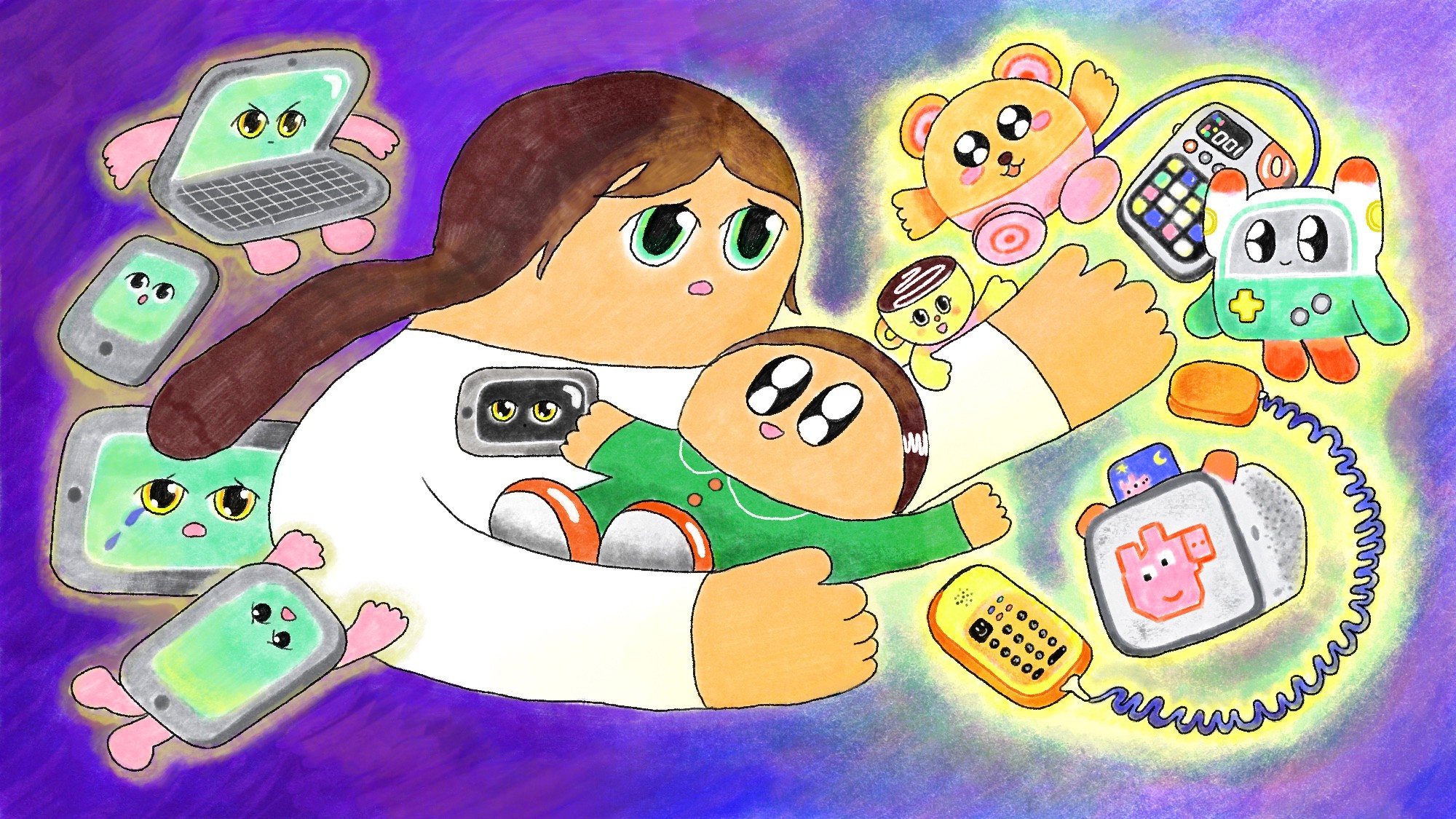
The Allure of the Anti-Screen-Time Toy
Bondu is a stuffed dinosaur that speaks 27 languages. It—or, more precisely, the AI chatbot embedded inside it—can also play games, help with homework, and patiently answer a child’s questions, even the really inane ones. Its “bedtime mode” includes breathing exercises and stories. Bondu, which costs $300 and comes in four colors, is marketed as a playmate, a confidant, a teacher, a quasi-caregiver. The ads take pains to talk up its safety controls, including an app that allows parents to review the conversations that Bondu is having with their child, as well as its ability to adapt to a child’s mood, interests, and age. And they emphasize, repeatedly, that the product is “screen-free.”This is an odd and technicality-laden argument to make about an object that contains the kind of computing power that would have basically been science fiction even a couple of decades ago—sort of like marketing a hand grenade as “bullet-free.” But Bondu knows its audience. What the toy is might be less important than what it isn’t. In one testimonial posted to Bondu’s website, a girl who looks to be about 4 years old chitchats about baby animals with her Bondu, whom she has named Rosie. The video cuts to a mom sitting cross-legged on the floor and smiling into a front-facing camera. “Camryn truly loves sharing about her day with her Bondu,” she says. “And I love that it’s something she can interact with that isn’t a screen.”Screen time can be a problem—the American Academy of Pediatrics says so; many early-childhood educators say so; well-meaning in-laws do too. Unfortunately, screen time also rocks, in that it is about the only way to occupy a child while you wash the dishes or have a little lie-down or go to work or do any of the other necessary or pleasurable activities life demands and invites. The one thing that feels more urgently worse than plopping a kid in front of the TV is the desperation that forces it. And then, later, the guilt.According to a survey conducted last year