AI agents need context everywhere they run, even where the cloud can't follow
Why this matters: a development in AI with implications for how people work, create, and decide.
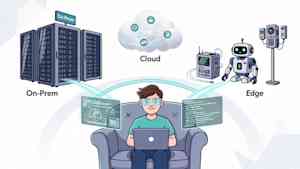
The competitive edge in enterprise AI is shifting to context: which platform can give an agent the right memory, the right retrieval and the right data at the moment of decision.Couchbase on Tuesday announced its AI Data Plane, combining persistent agent memory, real-time context retrieval and an enterprise-managed MCP server in a single operational platform. Couchbase's roots are in caching and high-transaction databases — an architecture the company argues makes it better suited for agent memory than vendors that came to the problem from search or analytics. The AI Data Plane runs identically across cloud, on-premises and disconnected edge environments, extending agent memory and local vector search to devices with no network connection."How do you make sure that the intelligence that you get out of these models are the ones that databases specialize in?" Gopi Duddi, CTO at Couchbase, told VentureBeat. "How can you get that value out of storage systems, which are still going to be databases?"What the AI Data Plane deliversThe AI Data Plane packages three components designed to replace the fragmented stacks most enterprises are currently running.Agent memory: A unified persistence layer for conversational context, structured operational data and vector embeddings. Couchbase says the guardrails are what distinguish it from standalone memory services: token constraints per session, time-to-live limits on stored memories and metering controls that cap compute consumption per agent session.Enterprise MCP server: An enterprise-supported self-managed server for standardized model-context protocol integration, shipping as part of the platform rather than requiring a separate service.Agent catalog: A function-level catalog of discoverable agent tooling built by Couchbase. Duddi distinguished it from metadata catalogs like Databricks Unity or AWS Glue — describing it, in his words, as closer to a glorified MCP that surfaces agent functions as callable tools within the