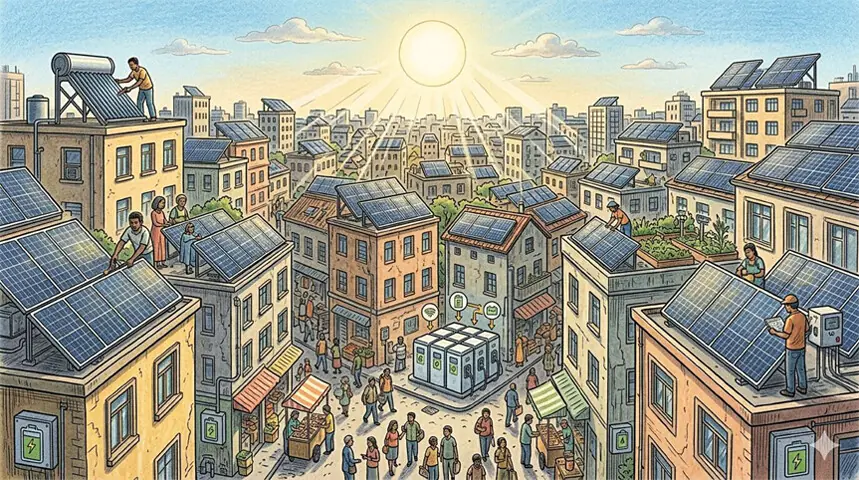
Going Green with Solar
Why this matters: local context for readers following news across Pakistan and the region.
PAKISTAN is undergoing an energy revolution unlike any the country’s planners designed, any donor funded, or any government blueprint envisioned. Rooftop by rooftop, tubewell by tubewell, factory floor by factory floor, ordinary Pakistanis are building one of the fastest clean energy transitions ever recorded. In a country simultaneously battered by catastrophic floods, record-breaking heatwaves and an electricity tariff crisis of its own making, the sun has become both an escape route and, quietly, a contributor to Pakistan’s climate commitments. This is the story of that revolution, and the storm gathering in its wake. The roots of Pakistan’s solar revolution lie in a catastrophic confluence of policy failure, global market forces and consumer desperation. Between 2021 and 2024, electricity tariffs surged by 155 per cent, driven by IMF-mandated removal of subsidies, soaring fuel costs from the Russia-Ukraine war, and capacity payments owed to idle CPEC-era thermal plants. At the peak, electricity bills in some households exceeded monthly house rent in major cities. Simultaneously, Chinese solar manufacturers faced massive overproduction. Panel prices fell from 32 cents per watt in early 2024 to 17 cents by yearend, and further to USD 0.08 per watt by 2025. This ‘perfect storm’, soaring grid costs meeting collapsing panel prices, ignited an unprecedented consumer response. In FY 2024-25, Pakistan imported 18GW of solar panels, according to Ember and Renewables First, building on 16.6GW in 2024. Cumulative imports reached 51.5GW by November 2025, making Pakistan the third-largest destination for Chinese solar exports. Solar’s share of utility electricity tripled from four per cent in 2021 to 14pc in 2024, reaching 25.3pc by early 2025, placing Pakistan among fewer than 20 countries to achieve that milestone. The consumer-led revolution has been remarkable, but it has also brought in its wake a storm that the government needs to address rather urgently and effectivel