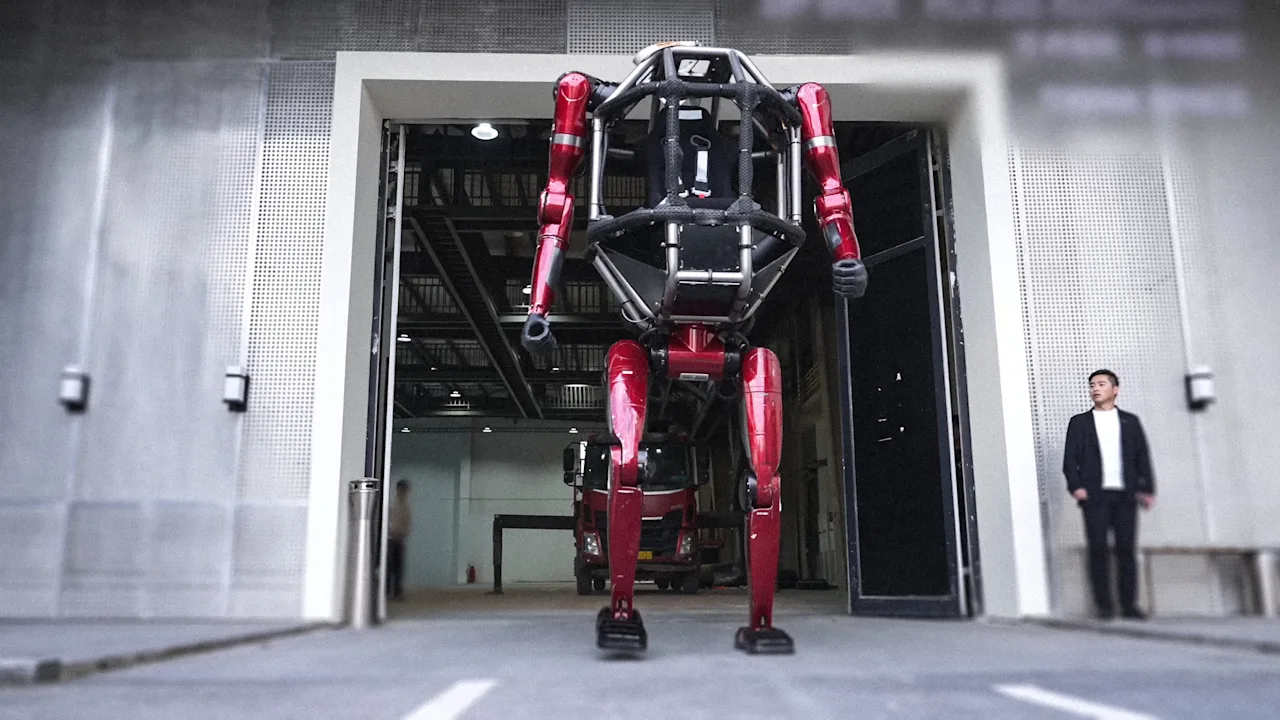
Unitree’s new robot is like a giant Transformer come to life
On May 12, Unitree Robotics founder Wang Xingxing climbed into the chest cavity of a 9.8-foot-tall metal robot, walked around, and destroyed a concrete brick wall. One punch. Wall gone. The Chinese media reaction was instant: “Unitree really built a ‘Gundam’!” That was a wild exaggeration, but there’s a kernel of truth to it. The GD01 feels like the first version of something much bigger. Not in size, but in scope. China is waging a full-spectrum push into embodied AI—“digital brains” with physical bodies that perceive and act on the real world—and it’s playing out simultaneously across daily life, logistics, heavy industry, medical care, and military applications. [Image: Unitree] Behind the spectacle of this new giant robot an entire industrial ecosystem is already quietly reshaping the country’s mining, manufacturing infrastructure, airport terminals, and high-voltage power grids. We are at the very beginning of this shift, and its practical consequences are only starting to surface. Built from a skeleton of titanium alloy and aerospace-grade aluminum with a carbon fiber shell, the GD01 is designed and engineered almost entirely in-house by Unitree—a company that, alongside fellow Chinese startup AgiBot, has emerged as arguably the world’s most consequential robotics manufacturer. First of many GD01 weighs 1,102 pounds and is priced at roughly $574,000. The company calls it the “world’s first mass-produced transformable mecha,” a title that is accurate. While some amateur fans have built mechas before, those units weren’t designed for work but rather for show, and none of them had the extraordinary capabilities and dexterity that GD01 shows. The robot transitions between two movement modes: upright on two legs or down on all fours. That four-legged mode works exactly like you’d expect: Drop the center of gravity, spread the weight across four contact points, and the machine stays stable over rough terrain that would tip a bipedal rig