High Dynamic Range DIY Air Testing
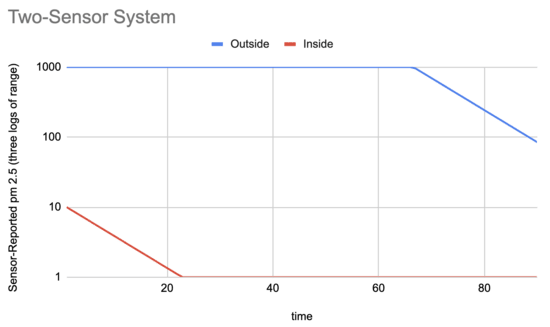
DIY testing of air cleaning is practical, and thoughtful experimental design can substitute for high-quality sensors including for evaluating air purifier setups that give >100,000x particle reductions. I've done a lot of DIY testing over the years ( 1, 2, 3, 4, 5, 6). The goal is generally to understand how well something removes particles from the air. A professional particle counter (example) costs thousands of dollars, and they're amazing devices, but what you're paying for is convenience, reliability, calibration, and dynamic range. If we're willing to give up on convenience and buy multiple devices for reliability, we can cheaply address calibration and dynamic range with experimental design. The cheapest ready-to-go option for DIY work today is probably the Temtop P600 which I see as $70. While I haven't tried it, it's a stripped-down version of the Temptop M2000 which I bought several years ago to use for my DIY experiments. If you want to make something cheaper, you can get a PMS5003, which I see as $21, and connect it to a cheap SoC (~$10) or to an Android phone (adapters in the $15 range). At scale I think you could get this down below $15: a PMS5003 or clone at high volume would be ~$7, the phone adapter would be under $1 at this scale, software <$1, then a box, assembly, and some QC. The Temtop and PMS5003 are somewhat calibrated, but fortunately we don't need to know absolute particle counts. We just need some number that is, within a reasonable range, linearly proportional to particle counts. As long as the meter is stable over time we can look at ratios. For example, if you're trying to see how quickly something can clear smoke from a room you don't need to generate a target amount of smoke or know exactly how much smoke you've generated: you can just measure the half life. This gives you relative efficacy directly or CADR if you have a sealed room of known volume. Dynamic range is harder, but still doesn't require professional sensors. Let's say you