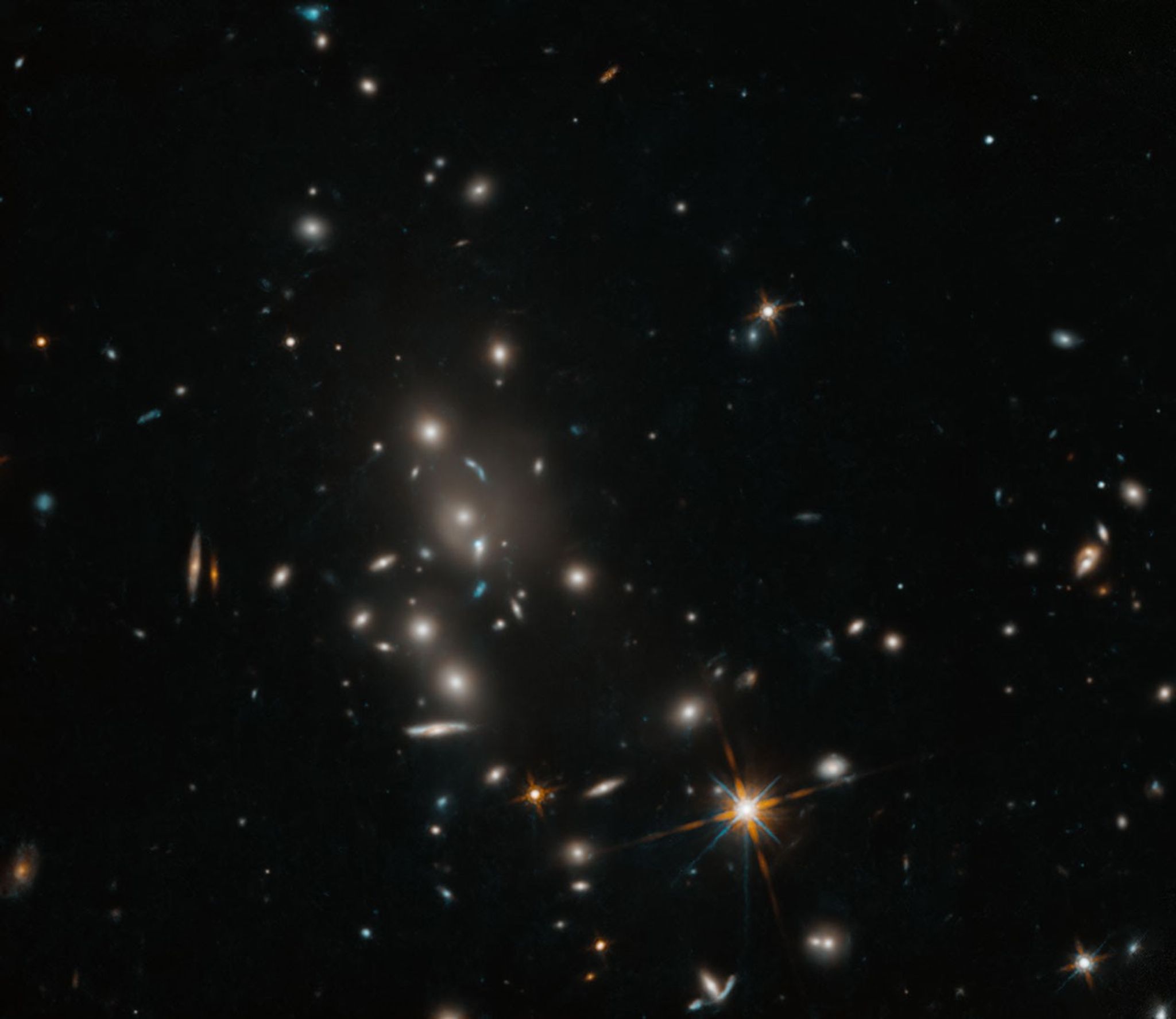
Hubble Captures Galaxy Cluster
Why this matters: new research or scientific developments with potential real-world impact.
Explore Hubble Hubble Home Overview About Hubble The History of Hubble Hubble Timeline Why Have a Telescope in Space? Hubble by the Numbers At the Museum FAQs Impact & Benefits Hubble’s Impact & Benefits Science Impacts Cultural Impact Technology Benefits Impact on Human Spaceflight Astro Community Impacts Science Hubble Science Science Themes Science Highlights Science Behind Discoveries Universe Uncovered Hubble’s Partners in Science Hubble & Citizen Science AI & Hubble Science Explore the Night Sky Observatory Hubble Observatory Hubble Design Mission Operations Science Operations Astronaut Missions to Hubble Hubble vs Webb Team Hubble Team Career Aspirations Hubble Astronauts Multimedia Images Videos Online Activities e-Books Sonifications Podcasts 3D Hubble Models Lithographs Fact Sheets Posters Hubble on the NASA App Glossary News Hubble News Social Media Media Resources 35th Anniversary More Online Activities 2 min read Hubble Captures Galaxy Cluster NASA’s Hubble Space Telescope captured this scene of galaxy cluster MACS J1141.6-1905 in visible and infrared light. NASA, ESA, H. Ebeling (University of Hawaii); Image Processing: G. Kober (NASA/Catholic University of America) Look closely at this image from NASA’s Hubble Space Telescope and you’ll see galaxies of various shapes and sizes clustered together toward the center-left of the image. A few foreground stars shine brightly and are easily distinguished by the spikes that appear to extend outward from each star. These spikes, called diffraction spikes, are the result of how point sources of light (such as stars) bend, or diffract, around the supports for Hubble’s secondary mirror. Hubble captured this scene of MACS J1141.6-1905 in visible and infrared light. The image includes data from two Hubble observing programs that looked at massive galaxy clusters that shine very brightly in X-rays. Both programs were looking for distant galaxies gravitationally lensed by the cluster. They also wa