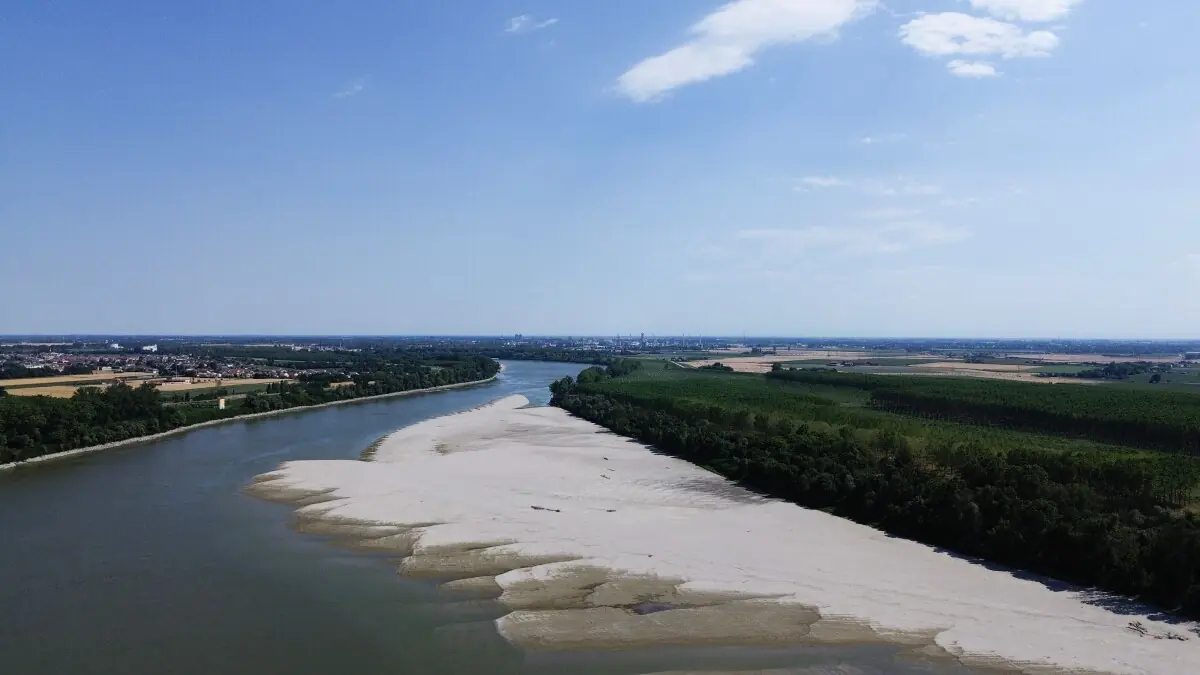
Farmers fear drought as Italy's longest river runs dry
Why this matters: local context for readers following news across Pakistan and the region.
Seawater is seeping into Italy’s longest river as the waterway starts to run dry in the heatwave, hitting a farming heartland that produces the milk for Parmesan cheese. The Po River has never fallen this low so early in the year, raising fears of a devastating drought in July in this corner of northern Italy. On the bank of one of its branches, farmer Federica Vidali looked anxiously at her sunflower field. The first bloom of the season has appeared, but part of the field is already dry and starting to crack. A local worker harvests clams in the cultivation area in the Po River Delta at Scardovari, Italy, northeast Italy, on June 26, 2026. — AFP One of the two canals that irrigate it has been shut because the seawater would enter and damage the crops. “We’re left with the water that others are willing to leave us. But we’re not second-division farmers!” Vidali told AFP. The Po River’s flow has collapsed in a matter of days, dropping below 300 cubic meters per second, compared with an average of around 1,500 in June, according to the Interregional Agency for River Po (Aipo). Clam harvesters work in the shallow waters of the Po River Delta at Scardovari, Italy, collecting clams by hand in the lagoon, northeast Italy, on June 26, 2026. — AFP “It has never dropped so fast, so early,” said Stefano Calderoni of the Italian National Association of Land Reclamation and Irrigation (Anbi). Sandbanks are multiplying, depths fall to barely one metre in places and the river’s few remaining fishermen swelter in the heat. An aerial view shows workers harvesting clams clearing the cultivation area of seaweed in the Po River Delta at Scardovari, Italy, northeast Italy, on June 26, 2026. — AFP “Before, we used to pass on the left; now the passage is to the right of the sandbank, and it’s very, very narrow,” said Daniela Cuoghi, a surveyor for Aipo. The many Alpine lakes that feed the Po Valley, Italy’s agro-industrial heartland, are still about 60 per cent full. But farmers are draw