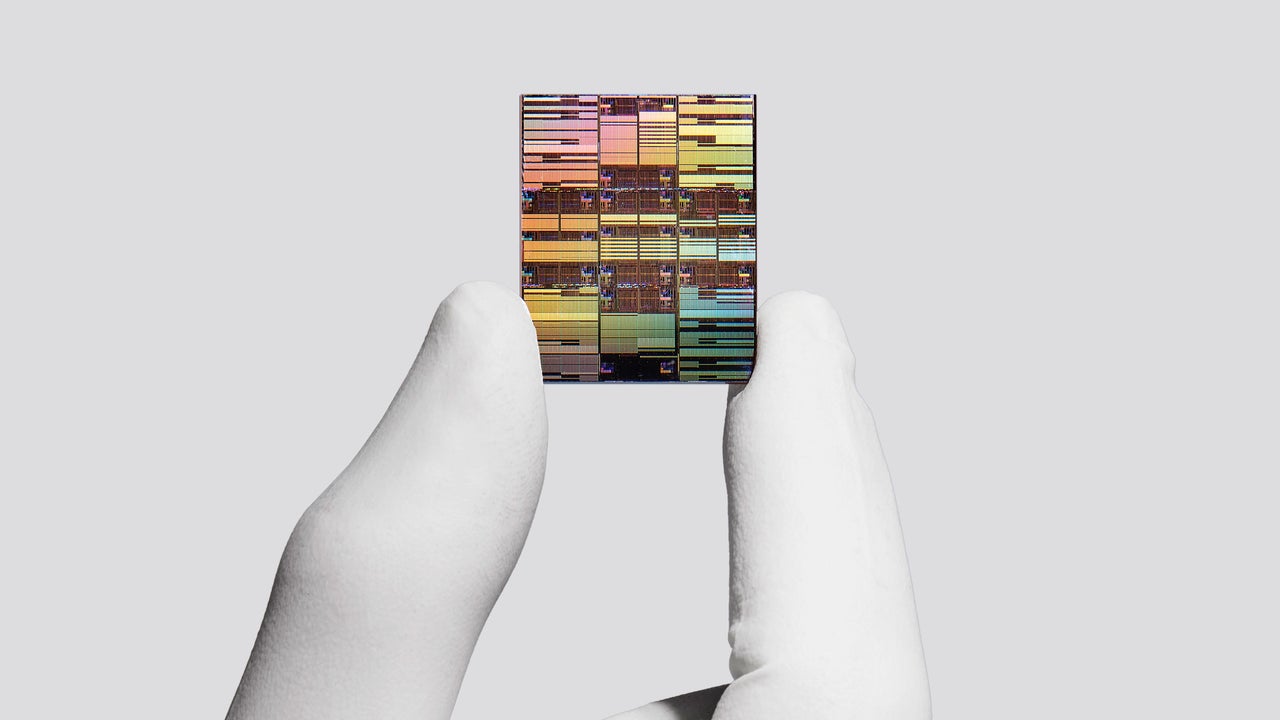
IBM debuts world’s first sub-1 nanometer chip technology
IBM unveiled what it calls a “major semiconductor breakthrough” today, with the introduction of the world’s first sub-1 nanometer chip technology. The new chip “node”—a manufacturing process and its design rules—can pack 100 billion transistors onto a chip the size of a fingernail, nearly twice the density of IBM’s 2 nm node chip, which revolutionized the industry when it was unveiled in 2021. Achieving sub-nanometer scale has been a key industry milestone on the path to smaller, more powerful, and more energy-efficient chips. The names of transistor nodes now refer to generations of manufacturing technology rather than exact physical dimensions. In this case, it means atomic-level engineering—with transistors incorporating three sheets each 5 nanometers, about 15 atoms, thick, with a distance between sheets of 9 nanometers. “We have entered a domain in semiconductor manufacturing [that] works between magic and physics,” said Huiming Bu, VP of IBM Semiconductors Global R&D at IBM Research, in a virtual press conference earlier this week. “We actually deposit [each] layer atom by atom.” [Image: IBM] The chip breakthrough involves more than just smaller transistors, though—it also introduces an entirely new “nanostack” architecture. The innovation builds on the nanosheet architecture used in the 2 nm chip process. In that configuration, transistors are arrayed in thin films, which are closely stacked on top of each other and surrounded by a gate. In the sub-nanometer chips, stacks of transistors are staggered across two separate wafers, which are connected by an innovative dielectric bond. It’s like the difference between a simple layer cake and a checkerboard cake. In published technical results, IBM projects the new chip will offer up to 50% more performance or 70% greater energy efficiency than IBM’s 2 nm node chips—helping scale applications ranging from generative AI and cloud infrastructure to next-generation electronic devices. The company also touts a 40% impr