Taxing Small Cars To Improve MPG
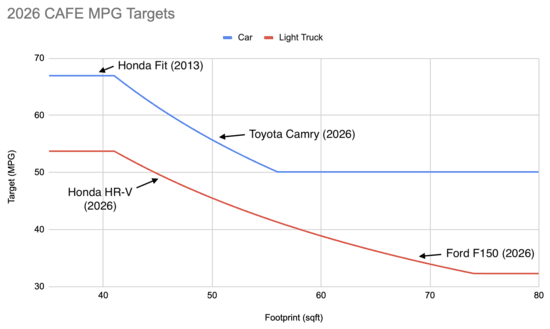
Cars and trucks are getting bigger, and I had a vague sense that fuel economy regulations were partly to blame. Looking into it, it's hard to say how much is regulations vs people wanting to buy vehicles that look rugged, but the regulations really aren't helping. This chart is the core of it: This is what manufacturers were looking at when they decided to build today's cars. To figure out the target fuel economy for a vehicle you first calculate its "footprint", which is the area between the wheels. On our 2013 Honda Fit that's 4.8ft side-to-side and 8.2ft front-to-back, for a footprint of 39sqft. Then you ask if it's a car or truck. This tells you which curve to use, and where along it to look. Looking at the chart we can now see why it's hard for Honda to sell a Fit today. The best Honda could do for a five-seater non-hybrid hatchback is maybe a CAFE rating of 44mpg. [1] This puts them 23mpg short, and if Honda was a one-model car company they'd expect to owe $3,910/vehicle in fines: $17 per 0.1mpg shortfall. Since the regulation is about an average across all the cars they sell the actual effect is both lower and more complex, and maybe something like $2k. Aside: the fine structure here is a sad artifact of us thinking in miles-per-gallon instead of gallons-per-mile. Going from 25mpg (0.04 gpm) to 50mpg (0.02 gpm) saves as much gas as going from 50mpg (0.02 gpm) to infinite (0 gpm). But the penalty for being below a target is calculated on the gap in miles-per-gallon and not gallons-per-mile. If you miss a 50mpg (0.02gpm) target by hitting 25mpg (0.04gpm), or miss a 75mpg (0.013gpm) target by hitting 50mpg (0.02gpm), you pay the same fine even though the first involves burning much more counterfactual gas: over 10,000 miles the first burns 200 gallons more than its target while the second only burns 67 more. What did Honda do? They discontinued the Fit, and replaced it with the HR-V. It's bigger and heavier, and looks like it was trying to be a "light truck". Co