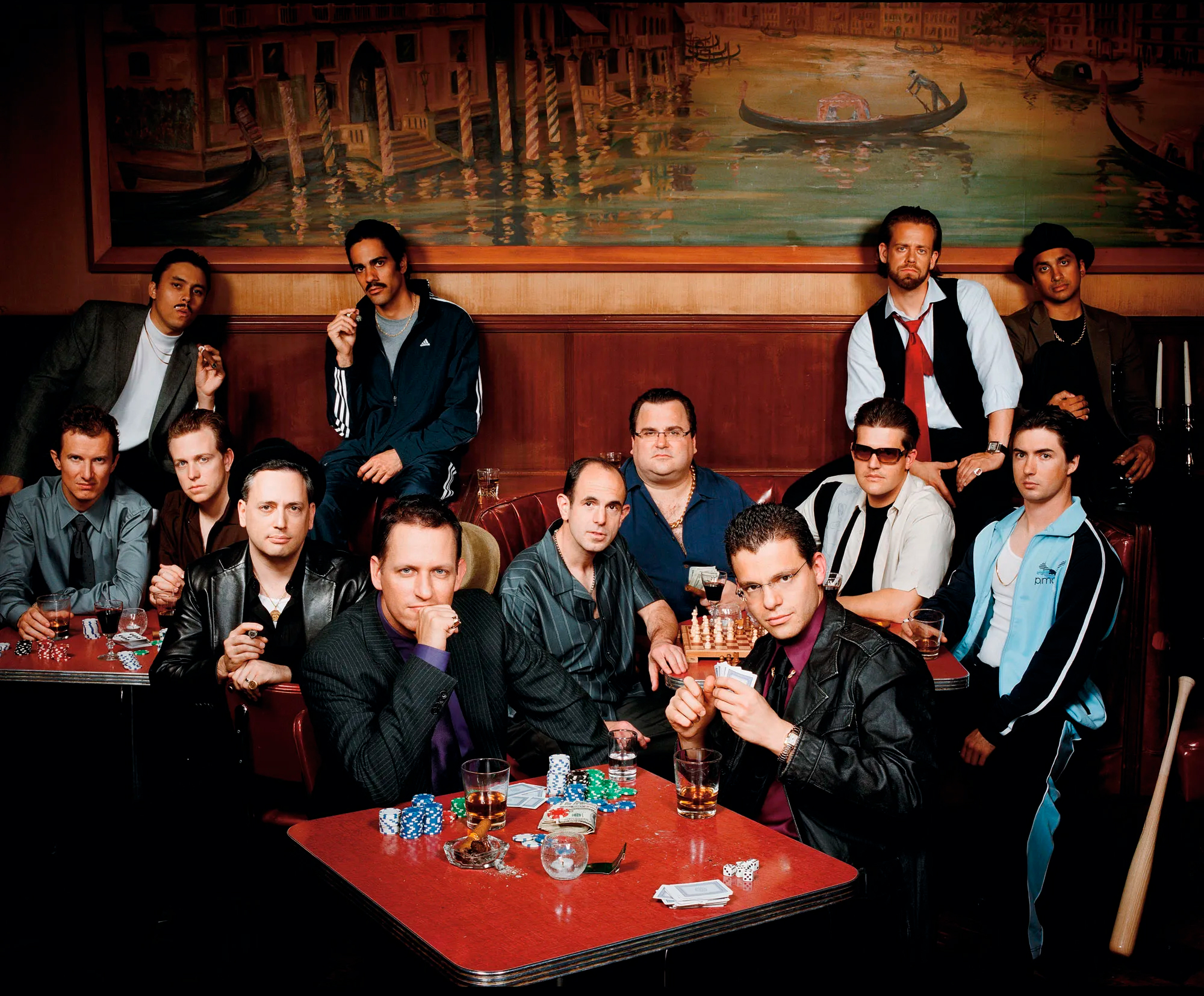
The ‘PayPal Mafia’ built a $1.5 billion fintech pioneer. The company they left behind is on life support
Nineteen years ago, in a Fortune cover story that christened the group, the so-called “Pay Pal Mafia” gathered in San Francisco for a photo shoot. There were gold chains, tracksuits, Maker’s Mark, Sinatra singing through the Wurlitzer. Peter Thiel had a butler, Fortune’s Jeffrey O’Brien discovered—“holy cannoli”—while Max Levchin wore mismatched freebie shorts. Elon Musk skipped the photo shoot to collect an innovator-of-the-year award, but Reid Hoffman, David Sacks, Roelof Botha, Jeremy Stoppelman, Jawed Karim, Chad Hurley—they were all there or thereabouts, having recently sold PayPal to eBay for $1.5 billion and scattered into dozens of enterprises which Fortune valued at the time to be “worth a total of roughly $30 billion.” That $30 billion valuation now, of course, feels quaint. The mafia went on to build or fund Facebook, LinkedIn, YouTube, Yelp, Tesla, SpaceX, Palantir, Affirm, and a meaningful slice of the venture capital industry that then bankrolled mostly everything else in Silicon Valley. They produced presidents of companies, elevated a sitting Vice President, and one even became the richest man on Earth. Meanwhile, the company that made their name keeps faltering towards the point of no return. The company beat expectations in their first quarter 2026 earnings; $8.4 billion in revenue against $8.05 billion expected and an earnings-per-share of $1.34 against $1.27. Still, the market shoved the stock down about 10%, to about $45.50 a share. PayPal’s new CEO Enrique Lores, in his first earnings call, announced a “strategic reorganization” that sounded involved: a new, three-unit operating model and the now-mandatory pledge of “aggressive adoption of AI.” But it might be too late for AI to save the stock. PayPal has suffered as they’ve been losing their share to Apple Pay, Google Pay and Shop Pay over the years. Growth, they announced in Q4, decelerated from 6% all the way down to 1% year-over-yea