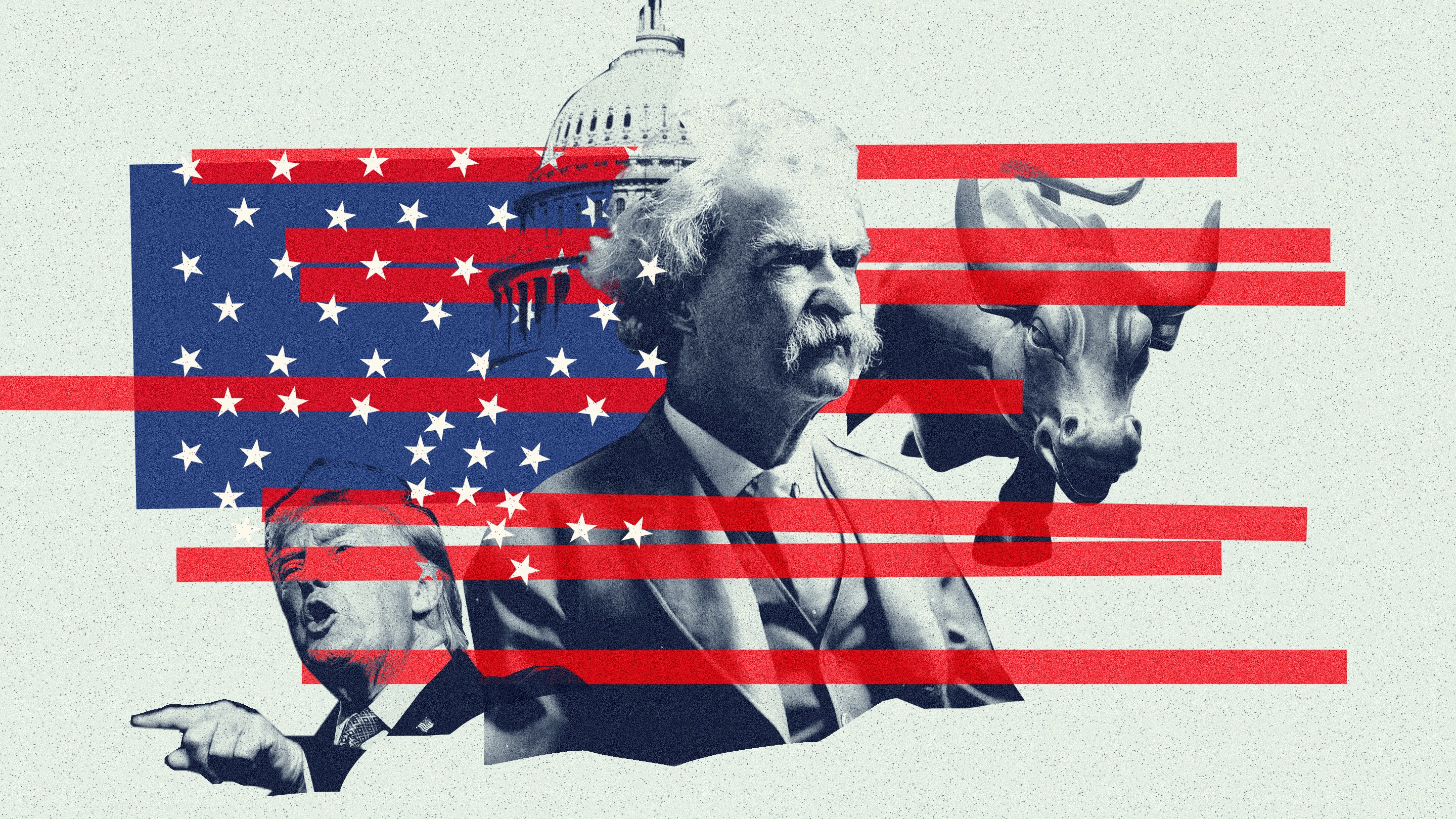
What Would Mark Twain Think of America at 250?
So what would Mark Twain—a man never at a loss for opinions—make of America on the 250th anniversary of its birth? He wouldn’t be surprised to be asked, or bashful about answering. As he once wrote in his notebook, “I am not an American. I am the American.” Arguably a bit vain, but essentially correct, since he encompassed much of the best (and occasionally the worst) of our national character.Twain was our shrewdest satirist of greed and corruption, and he would find plenty to be appalled about in today’s second Gilded Age. It was Twain who minted the term The Gilded Age—the title of his first novel, co-authored with his friend Charles Dudley Warner and published in 1873, when Twain was 37 years old—and he had scathing things to say about the wild carnival of greed that followed the Civil War, decrying the “incredible rottenness” and “moral ulcers” of an America in thrall to big business. He published a revised catechism for the rich: “What is the chief end of man? A. To get rich. In what way? A. Dishonestly if we can; honestly if we must.” He castigated Jay Gould, the notorious Wall Street speculator, for fostering a greed-is-good mentality: “The people had desired money before his day, but he taught them to fall down and worship it.” Today Twain would likely blanch at the billionaires congregating around President Trump at Mar-a-Lago. And in the euphoric greed of Wall Street, he would spot many latter-day examples of Colonel Sellers, the money-mad humbug in The Gilded Age who sees millions in every flimsy enterprise.Twain’s critique had power because he was very much a product of the society he chastised. When he wasn’t satirizing plutocrats, he was trying very hard to become one. He amassed a sizable fortune from books and lecture royalties and from marrying a minor heiress, Livy Langdon, whose father had sold coal to Cornelius Vanderbilt’s railroads. The couple luxuriated in a 25-room mansion in Hartford, Connecticut, staffed by six servants.He hoped to get eve