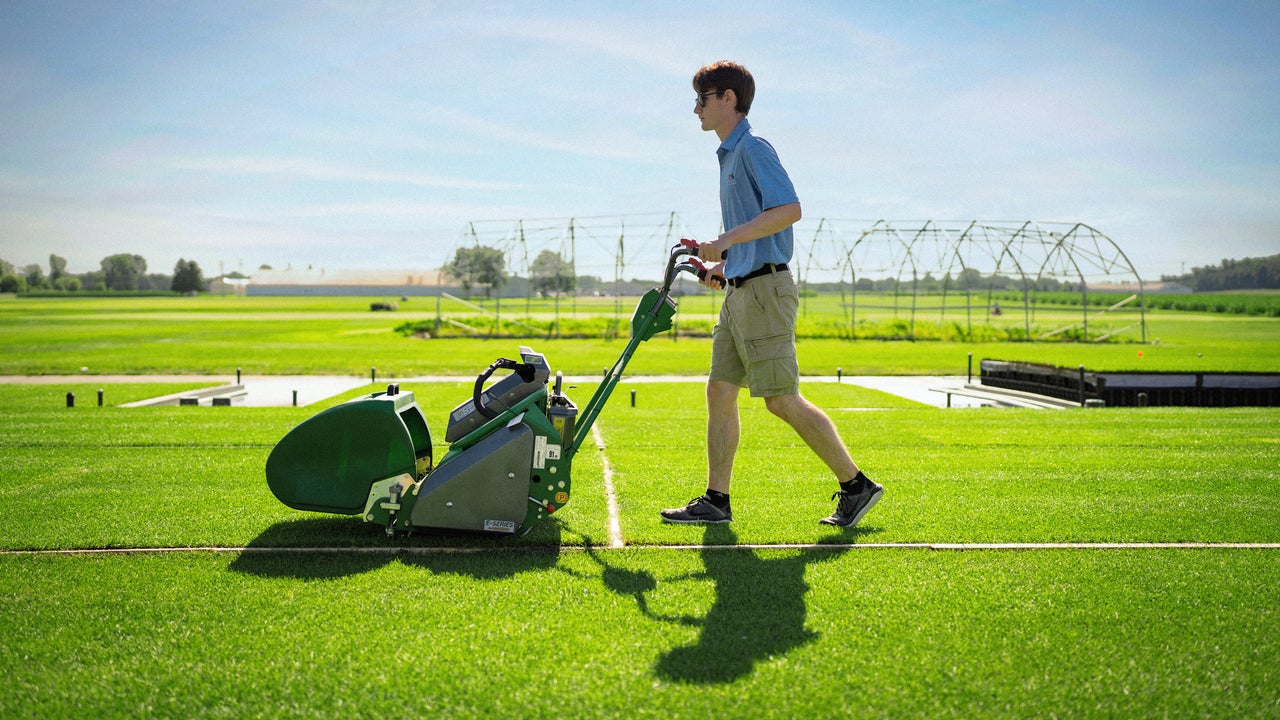
Inside the painstaking, yearslong process of making perfect grass for the World Cup
The 2022 FIFA World Cup hadn’t even started when researchers set out to grow the perfect pitch for the 2026 World Cup, which kicks off in cities across North America this month. Long before teams had even qualified to play in this year’s tournament, FIFA hired two teams of researchers from Michigan State University (MSU) and the University of Tennessee (UT) to develop the turf grass that would serve as the playing field for its most unconventional World Cup to date. Set in three different countries, 16 different cities, 10 different climatic zones, and both indoors and outdoors, the games of the 2026 tournament will be the most diverse in the Cup’s history. FIFA wanted these very diverse games to have playing fields that were as similar as possible. [Graphic: Howard Davy] It’s a task the researchers took on as a design challenge. To solve it, they started mixing seeds. Over the course of nearly three years, the researchers tested different combinations of grass types that could grow into a dense sod that would be strong enough to withstand top-level soccer play in up to nine games over the 39-day tournament, all while persevering through the wildly different climates of the 16 host cities, which range from Toronto to Seattle to Dallas to Miami to Mexico City to Guadalajara. From left: John Sorochan and John “Trey” Rogers III. [Photo: Nick Schrader/Michigan State University] The project was led by John “Trey” Rogers III, a professor in MSU’s College of Agriculture and Natural Resources, and his former PhD student, John Sorochan, now a distinguished professor in turfgrass science at UT’s Department of Plant Sciences. Rogers says the final grass combination they developed ended up being a very precise mix of 84% Kentucky bluegrass seed and 16% perennial ryegrass seed. MSU turf grass researchers, professors, and students prepare turf for the 2026 World Cup, hosted in the United States. This is a collaboration b