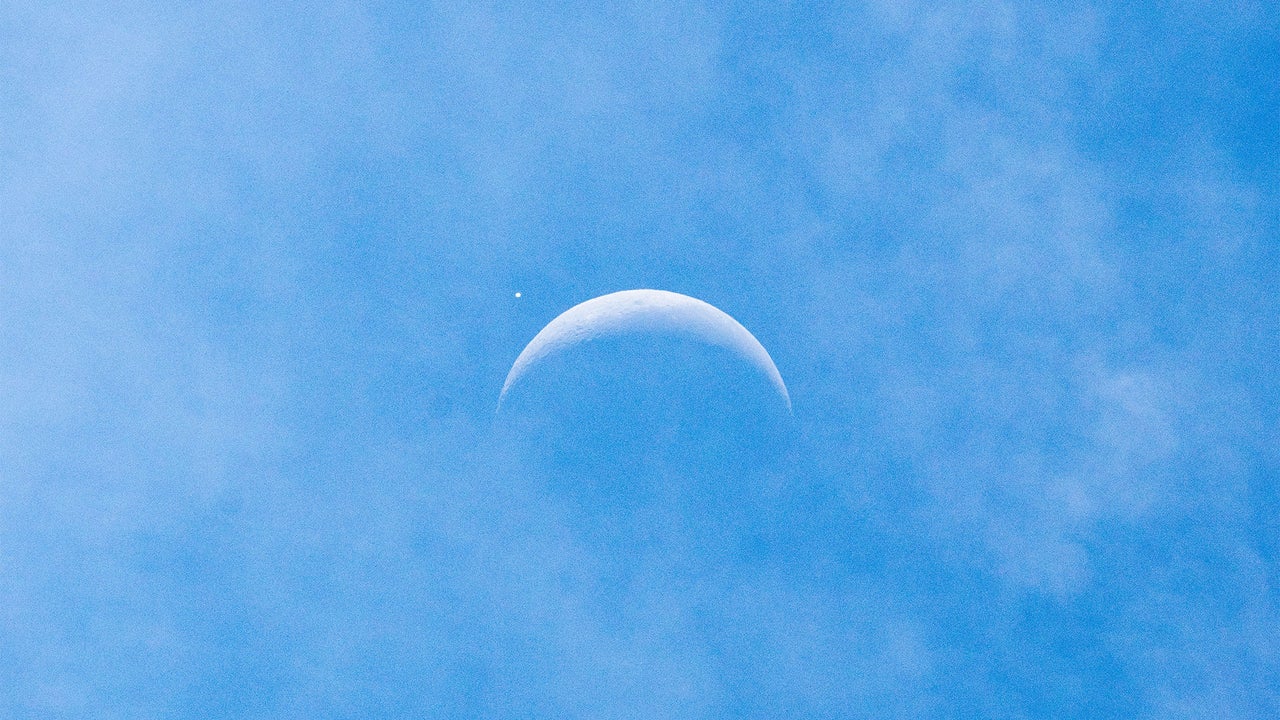
Don’t miss it: Venus will vanish behind the moon in a rare daytime event on Wednesday
A rare astronomical event will make Venus briefly disappear from the sky on Wednesday—and some US states will be able to spot it. On June 17, skywatchers in the US may witness the waxing crescent moon eclipse Venus, the brightest planet in our solar system. The event is set to last about an hour and will be visible in about 48 states, as well as northeastern South America like Brazil and Venezuela, and parts of Canada. The type of event is known as a lunar occultation, where a planet disappears behind the moon’s edge until reappearing a short time later. The astronomical phenomenon is quite rare, with Wednesday’s event marking the first time in 11 years since this type of lunar occultation has been visible in the US. Additionally, most celestial events require dark skies for optimal viewing, while this one will be visible in broad daylight. At the time of the event, the moon is set to be zero days past full moon and at 11% illumination. The event is set to begin at 11:40 a.m. Pacific Time and around 4 p.m. Eastern Time. The visibility of the lunar occultation will cross the contiguous US, visible from 18:33 through 21:26 Coordinated Universal Time—although the exact starting time depends on each specific location. Those outside of the viewing region may still see Venus appear closer to the moon than usual. If you’re hoping to catch the event, the International Occultation Timing Association (IOTA) has put together a handy guide that includes a visibility map and city-by-city timing estimates for Venus’s disappearance and reappearance. The times are shown in Universal Time (UT), so you’ll need to subtract 4 hours for Eastern Daylight Time, 5 for Central, 6 for Mountain, and 7 for Pacific. For those wishing to catch a glimpse of the event, binoculars are needed. Still, experts urge viewers to be careful of where they point the binoculars, as looking directly at the sun while using the device may cause blindness and permanent eye damage. Experts also