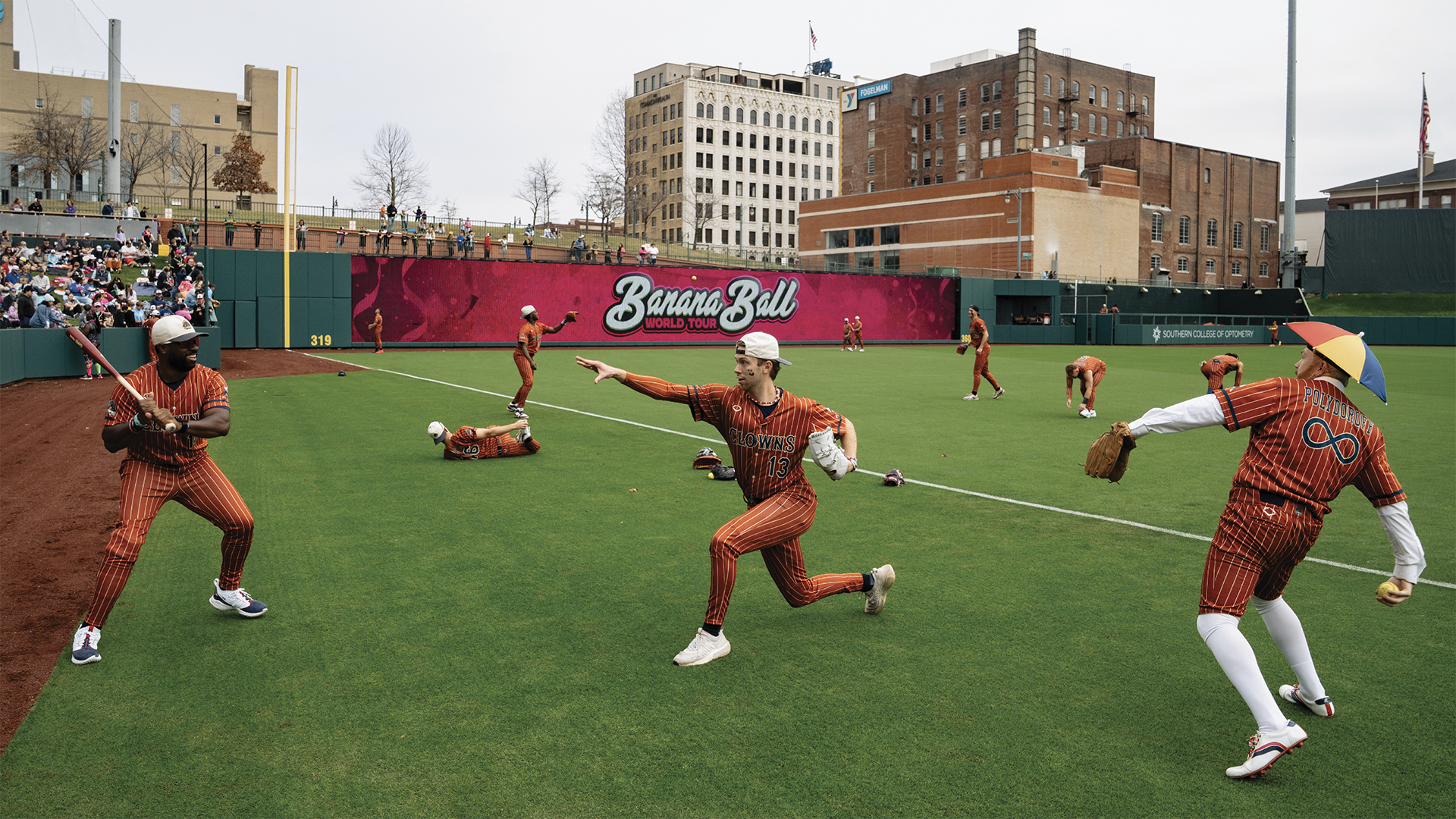
The Clown Show
Photographs by Kevin Wurm“My dad was a big Lakers fan,” Kobe Shaquille Robinson told me, indulging an admittedly obvious question. Robinson was born in 2001, in the middle of Kobe Bryant and Shaquille O’Neal’s three-NBA-championship run. But he discovered early on that his name couldn’t help him shoot a basketball. As an athlete, he stood out on the pitcher’s mound.Robinson is 6 foot 2 and lanky; when we met, he was wearing his hair in two-strand twists. We were talking on a Saturday afternoon in Memphis, in a retro-style downtown stadium named after an auto-parts chain. It was, in a way, the perfect venue for a conversation with an up-and-coming ballplayer—a minor-league park with all the trimmings of a major-league one. It was also, objectively speaking, an unusual workplace for a Black athlete in 2026.Back in the mid-1980s, during the prime of Ozzie Smith, Rickey Henderson, Tony Gwynn, and Dwight Gooden, more than 18 percent of Major League Baseball players were Black. Now that figure is just below 7 percent—right around where it was in 1956, less than a decade after Jackie Robinson broke the color line.No single reason explains Black Americans’ diminished footprint in the sport; the high cost of equipment and travel ball, dwindling municipal funding for youth leagues, the rise of the NFL and the NBA, and a parallel surge of Latino talent have all contributed. Despite these factors, Kobe Robinson still dreamed of a life in baseball. “I just felt like the man out there,” he said. “So I stuck with it.”Robinson’s fastball, which earned him the nickname “Hot Sauce,” carried him from a Tennessee community college to the 2021 MLB draft, where he was selected by the San Diego Padres. Injuries, however, stymied his early career: He had issues with his elbow, then his shoulder. In 2024, the Padres released him. The closest he ever got to the big show was A‑ball, three rungs below the majors.At 23, Robinson was out of baseball and, he said, “in a dark space.” He took overn