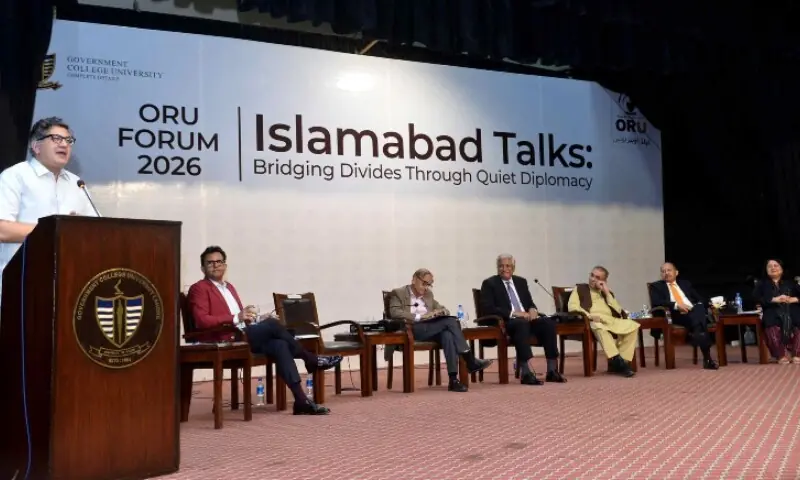
‘Domestic pressures in US, Iran may stall peace deal’
Why this matters: local context for readers following news across Pakistan and the region.
The discussion, titled ‘Islamabad Talks: Bridging Divides Through Quiet Diplomacy’, was hosted by the Old Ravians Union (ORU) at Government College University (GCU). Speaking on the occasion, former ambassador Mansoor Ahmed Khan said growing global polarisation had weakened the credibility of traditional mediators such as the European Union and Nato. In this context, he noted, Pakistan’s civil and military leadership had stepped in to facilitate engagement among key international stakeholders. He revealed that a proposal by Tehran to separate the reopening of the Strait of Hormuz from long-term nuclear negotiations was gaining traction and was being actively debated by the US National Security Council. Khan said the conflict had reshaped regional dynamics, leaving Israel politically isolated while positioning Iran as a resilient actor. He added that a new regional security framework involving Pakistan, Saudi Arabia, Turkiye, Egypt, Indonesia and China could emerge, though he cautioned that Pakistan’s peace efforts faced opposition and disinformation campaigns from India. Senior journalist Mujeebur Rehman Shami said Pakistan had acted proactively rather than waiting for external engagement. He warned that a US-led blockade had pushed Iran’s oil storage capacity to its limits, and any forced closure of oil wells could have long-term consequences, creating a strategic deadlock betwee