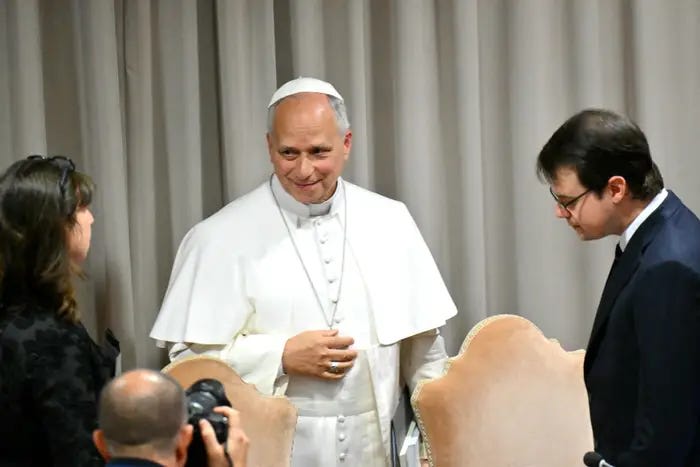
Claude, Author of the Humanitas
In the wee hours of Memorial Day, my friends and I stayed up past 4:30 AM California time to listen to the announcement of Pope Leo’s first encyclical, Magnifica Humanitas, on safeguarding the human person in the time of artificial intelligence. We were excited albeit sleepy, eagerly anticipating the event and upcoming essay by the world’s foremost religious authority on a question so central to our world. Still we were an odd audience for this presentation: none of us are practicing Catholics, and most of us didn’t really know what to expect.I thought Pope Leo’s own speech was good, and addressed the current moment in AI with some of the seriousness it deserves. I thought the other speeches, including by Chris Olah, were less impressive. But that’s okay, I’m not the target audience!A specific cardinal’s point struck me, however:Cardinal Parolin made much of a specific prepositional choice in the subtitle: “sulla custodia della persona umana nel tempo dell’intelligenza artificiale,“ which the live translator translated to something like “on the safeguarding of the human person in the time of AI,” and not “sull’intelligenza artificiale“ – “on AI.”This was supposed to be a big deal. “In the time of AI” supposedly centers the human person in the theological narrative, while a mere first papal encyclical on AI focuses too much on the technology itself and not on human and societal reactions. A fascinating position!Though as my subsequent analysis will demonstrate, perhaps a more apt preposition here is “by.” As in, the world’s first papal encyclical written in large part by AI.My article has the following claims, each of which I hope to convince you of:Significant fractions of the recent papal encyclical are written by AI. I provide multiple lines of evidence for this.We can corroborate the vibes and tonal indications with statistical evidence. Phrases and punctuation much more commonly used by AI are much more present in this papal encyclical than past encyclicals.The