Rubio starts first visit to India on heels of US-China summit
Why this matters: local context for readers following news across Pakistan and the region.
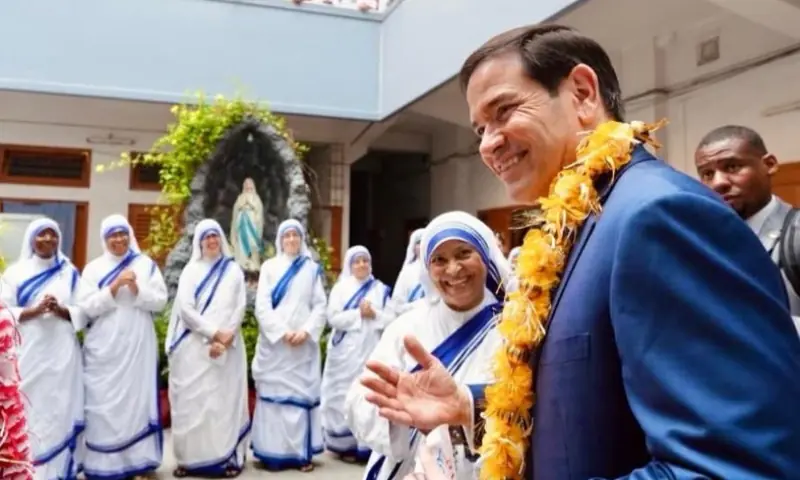
United States Secretary of State Marco Rubio on Saturday opened a visit to India that will include talks with Prime Minister Narendra Modi, looking to renew ties with a usually like-minded partner a week after Washington’s warm summit with China. Rubio, a devout Catholic, began his four-day, four-city tour by touring the headquarters of Mother Teresa’s charity in the eastern city of Kolkata and praying over her tomb. Wearing a yellow garland over his suit, Rubio, who was visiting India for the first time in his life, smiled before an assembly of nuns, all clad in the late humanitarian’s signature white and blue saris. “Rubio spoke about aiding the homeless, terminally ill and those afflicted by leprosy,” Sister Marie Juan of Missionaries of Charity told reporters after his hour-and-a-half-long visit. “He was happy to pray and we were also happy to have him,” she said. Sergio Gor, the US ambassador to India and also a Catholic, later posted that the visit showed that the countries’ relationship was based “not only on strong policies, but also on shared values.” Rubio, who is accompanied by his wife Jeanette, then flew to New Delhi, where he was scheduled to meet with Modi later on Saturday. Before leaving on Tuesday, Rubio will also take part in a meeting of foreign ministers of the so-called Quad — Australia, India, Japan and the United States — four democracies seen as a counterweight to China’s presence in the Indian Ocean. China has long been suspicious of the Quad, calling it an attempt to encircle it, and has chastised India in the past for taking part in it. But Rubio’s trip comes as President Donald Trump is shaking up traditional assumptions about US priorities. Trump paid a state visit to China last week, where he hailed the reception he received from President Xi Jinping despite limited concrete announcements. Trump in Beijing spoke of the United States and China being a “G2” — a formulation that had fallen out of favour in recent years as US allies fear b