How to get better at chess (and everything else)
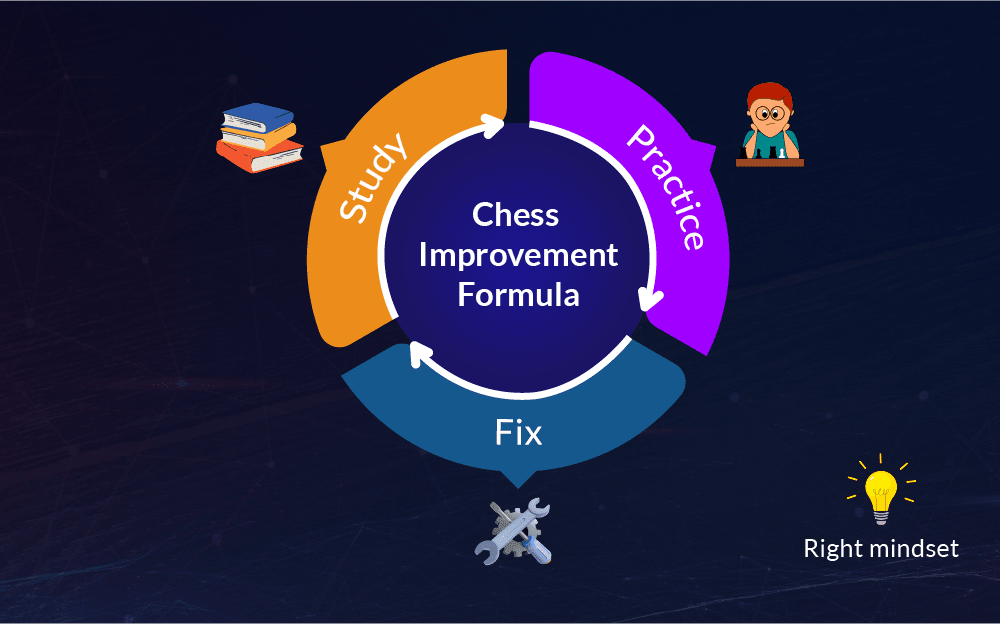
I've been following chess grandmaster Avetik Grigoryan for his chess improvement tips for a while. He has a tonne of great stuff on his website. The following is an extract from an article I think would be interesting to a bunch of people on Less Wrong.The chess improvement formula It’s quite simple.Study -> Practice -> Fix -> (Repeat) You learn something first.You practice it; otherwise, you’ll forget it.You fix the mistakes you make.Then you learn new things, and the cycle continues. Anything to add?Yes! The sauce.Everything you can do — studying, practicing, and fixing you can multiply the results with the secret sauce — the right mindset!Let’s go through this formula separately, and then I’ll tell you how I used it for learning my openings.Step 1 - StudyMy friend who was reviewing the article argued with me that the cycle should be practice 1st, and then 2. Study, and 3. FixI asked, “Did you start playing chess and then learn the rules?” After laughing, the topic was closed. So the 1st step is clearly “Study.”The mistake many experience is either never coming back to studying or not coming back frequently enough.I’ll tell you something astonishing.If you’re 1,500 on chess com, you’re better than 94% of all other chess players on the platform! A screenshot from my friend's friend's profileGuess why?Many start grinding after learning the rules, but never return to learning opening principles, or basic tactics like forks and pins.They never learn how to use weak squares, attacking and defensive techniques, the general principles of winning won positions, or basic endgames.Not surprisingly, they never improve, or if they do, it is only slightly.Step 2 - PracticeOn the contrary, many make the opposite mistake.They decide to study everything and then play.This is also wrong because you really really learn when you do.If you keep learning things one after another but never practice them, all your knowledge will be vague, and you’ll easily forget to use it during the gam