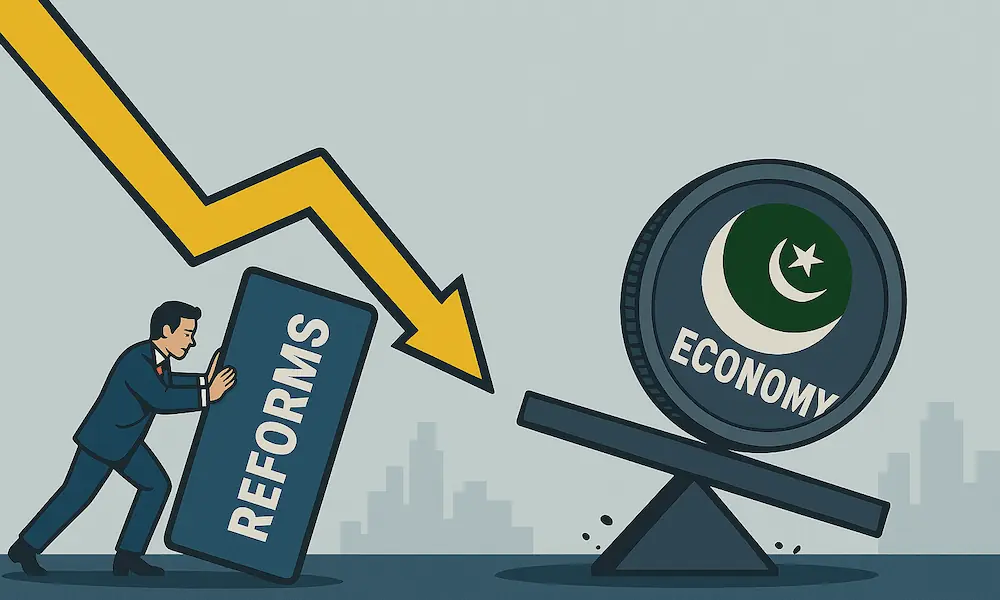
Economic path lost — the policy puzzle
Why this matters: local context for readers following news across Pakistan and the region.
Chasing ambitious economic targets without a coherent policy framework is like walking onto a cricket field without a bat — yet that is precisely what we insist on. We have been pursuing investments for a long time and are especially fond of foreign direct investment (FDI). We believe — and rightly so — that Pakistan offers a range of attractive opportunities for investors. However, the fact remains that our investment-to-GDP ratio, which averaged 18 per cent for nearly 40 years (1980s–2018), sharply fell from 17.2pc in 2018 to 15.5pc in 2019 in the very first year of the International Monetary Fund’s (IMF) ‘stabilisation’ programme, touching a historic low of 13.1pc of GDP in 2024. Meanwhile, FDI fell from 1pc to 0.5pc of GDP over the same period. Governments communicate with investors and businesses primarily through their policies, which enable them to navigate decisions by anticipating policy direction in the foreseeable future. In the absence of a clear, consistent and predictable policy environment, only speculative economic activities tend to flourish while the long-term investment horizon and risk appetite of investors and businesses are significantly constrained, according to Pakistan Policy Dialogue 2026, hosted by the Policy Research & Advisory Council (PRAC). The problem is not the absence of investment opportunities; the real challenge lies in creating a policy environment that makes these opportunities commercially viable and attractive The main hurdle in realising our economic ambitions is the disconnect between our plans and policies. The government’s key planning documents, Uraan Pakistan (2024-30) and the prime minister’s Economic Transformation Agenda and Implementation Plan (2024-2029) target economic growth of 6-7pc per annum while increasing per capita income by 43pc in dollar terms by 2029-30. On the other hand, the economic team is religiously following the IMF programme’s contractionary monetary policy of high real interest rates (4-5pc abov