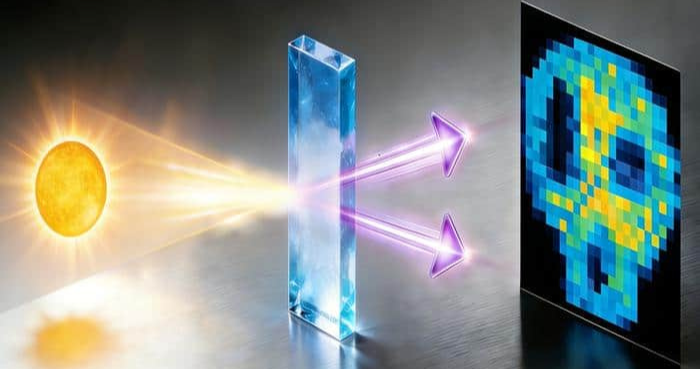
Quantum optics breakthrough uses sunlight to generate photons
Key takeaways
- This discovery could greatly simplify optical systems reliant on spontaneous parametric down-conversion (SPDC).
- SPDC usually happens when a photon with a short wavelength passes through a nonlinear crystal, splitting into twin photons with longer wavelengths.
- To test this idea, the Xiamen University team set up a special sun-tracking telescope on their lab roof.
Why this matters: local context for readers following news across Pakistan and the region.
Add ARY News on Google AAResize Researchers at China’s Xiamen University have made a significant breakthrough in quantum optics by demonstrating that entangled photon pairs, traditionally generated with complex, power-intensive laser systems, can instead be produced using natural sunlight.
This discovery could greatly simplify optical systems reliant on spontaneous parametric down-conversion (SPDC). Removing the necessity for conventional lasers enables the deployment of advanced quantum technologies in space or remote areas without electricity.
SPDC usually happens when a photon with a short wavelength passes through a nonlinear crystal, splitting into twin photons with longer wavelengths. Traditionally, this process needed a highly coherent laser beam to start. However, researchers Wuhong Zhang and Lixiang Chen proposed that the sun’s nsun’slly incoherent light could also trigger it.