Will we really put data centers in space?
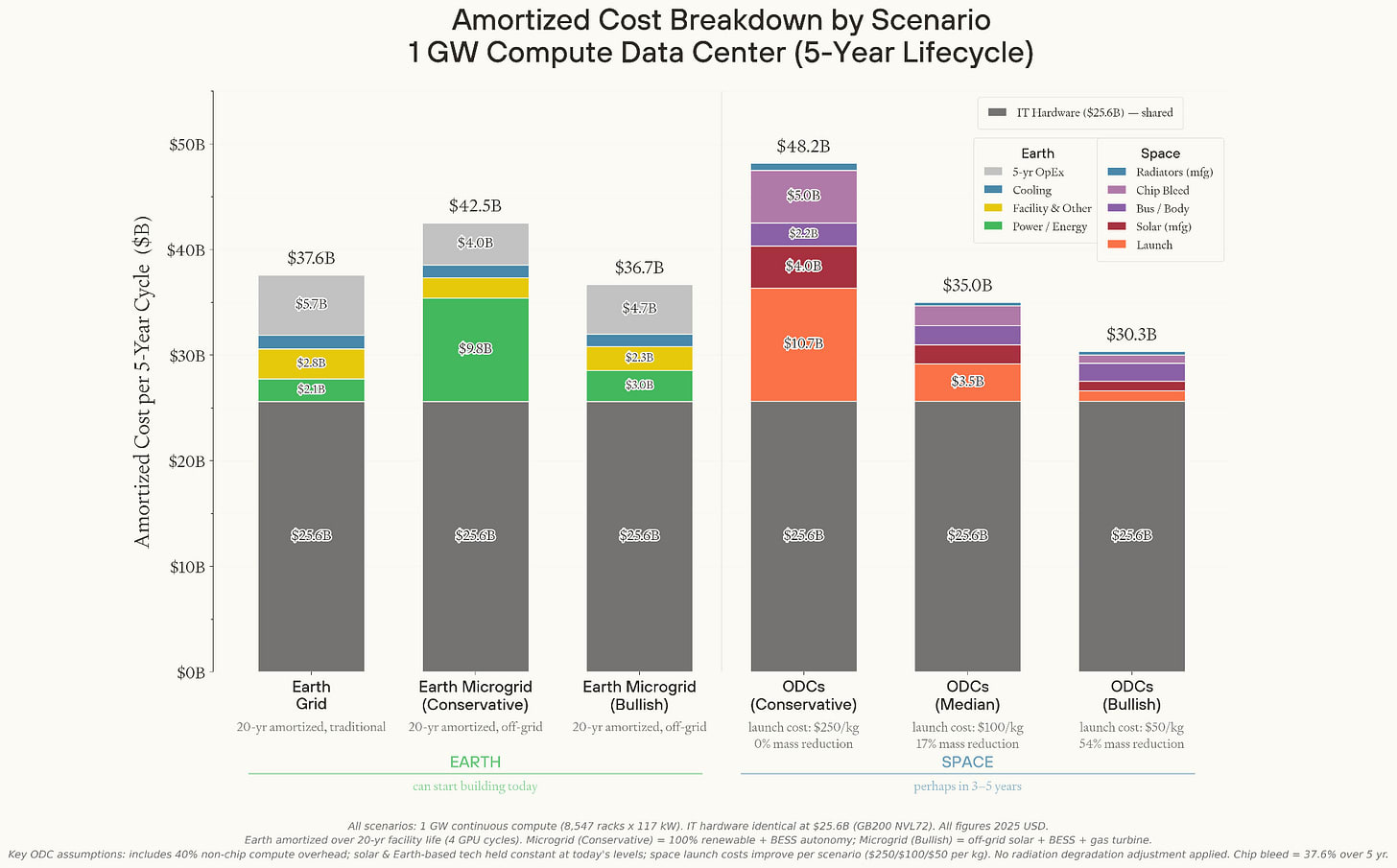
Abstract Several major technology companies have announced plans to operate AI data centers in orbit. Elon Musk recently claimed: “the lowest-cost place to put AI will be space […] within two years, maybe three.” If a meaningful fraction of new AI compute really is placed in space within a few years, that would be a fairly big deal for AI governance and strategy. Here we try to disentangle the hype from reality and provide a sober assessment of the technical and economic feasibility of orbital data centers (ODCs).The main case for ODCs is the cost of energy: space solar panels in the right orbits receive more constant and intense sunlight compared to Earth. Moreover, ODCs don’t currently face the same permitting and regulatory delays as on Earth, cause fewer ongoing environmental harms compared to grid or onsite natural gas-powered data centers, and may be more secure against data exfiltration. We find that the cost-competitiveness case for ODCs depends almost entirely on Starship achieving reusability comparable with what SpaceX achieved with Falcon: space-based solar reaches cost parity with present-day off-grid terrestrial power continuously at roughly $250/kg to orbit, and becomes cheaper than any current terrestrial energy source at around $50/kg, from the present-day cost launch cost of roughly $1,500/kg. Radiative cooling, often cited as a fatal obstacle, appears surprisingly manageable — potentially even cheaper than on Earth. However, ODCs may require substantial (perhaps ~38%) extra non-compute hardware (like solar, racks, and cooling) over 5 years to compensate for their inability to swap out failed chips, and inter-satellite bandwidth limitations likely confine ODCs to inference workloads, at least early on.Assuming no transformative AI,[1] but continued demand for data center buildout, we estimate that ODCs are unlikely to represent a meaningful share of compute before 2030, but become cost-competitive with present-day terrestrial data centers within 3–5