The AI Industrial Explosion — Part 3: Going faster
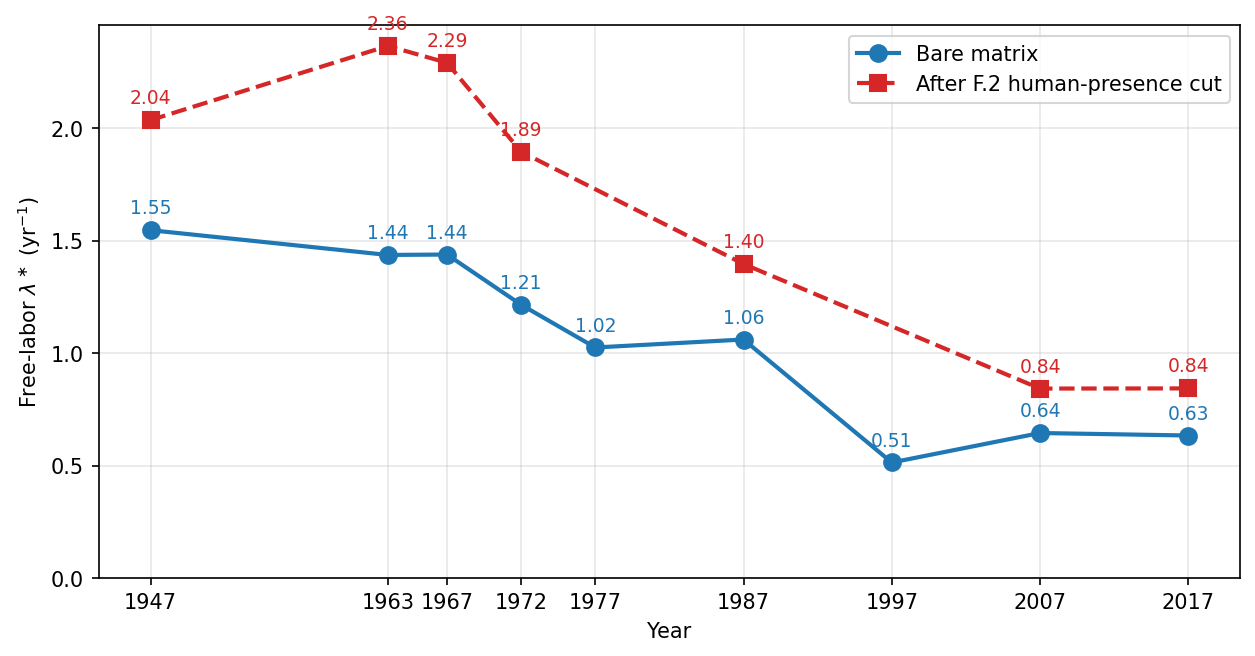
In Part 1, I found that a fully automated economy using today's production methods could double roughly every year. In Part 2, I modeled the transition from today's economy to that maximum-growth composition and found that energy production could double within about four years. Both parts held production methods fixed: each sector continues using exactly the recipes it uses today, with robots replacing human workers. That assumption is too conservative. Today's production recipes were chosen at very different factor prices from what a post-AGI economy would face. Labor is expensive today, so recipes minimize labor use. Humans must also be physically present, so recipes are built around them. Interest rates are low, so recipes lean on durable equipment that lasts for decades. Post-AGI, labor becomes nearly free and capital reproduces fast enough that effective interest rates rise sharply. This part asks how much faster the economy could grow when recipes are reoptimized for post-AGI factor prices, using only existing or historically-observed technology rather than novel improvements. The first section starts from the US 2017 input-output tables and applies four channels: stripping out the capital and services that exist only to accommodate human workers, closing the productivity gap between average and frontier plants, building cheaper short-lived capital, and shifting recipes toward more labor-intensive production. I also revisit Part 1's construction-lag treatment, as lags become increasingly important at higher growth rates. The second section turns to historical US input-output tables going back to 1947, and asks how much further the rate rises when each commodity can be produced using the cheapest recipe from any era. This part is a grab bag of different effects, each with its own uncertainties, but that largely stack together. My central estimate is that the economy's maximum self-reproduction rate is between 1 yr⁻¹ and 2 yr⁻¹, corresponding to doubling times o