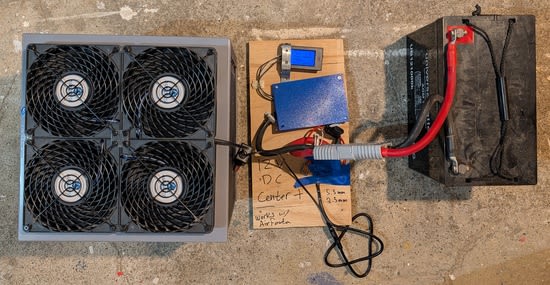
Running An Air Purifier on Batteries
Running an air purifier on a battery could be really useful in an emergency that combined a biological or nuclear threat with a power outage. Getting one that can run on 12V DC and attaching it to a Li Fe PO4 battery is about $188 (plus $164 for the purifier) for something that will give you 141 CFM for over a week. I've been thinking about DIY biohardening, primarily to reduce risks from environment-to-human threats, and a lot of what's out there assumes the power grid stays up. This doesn't seem like a good assumption: even if society does a fantastic job protecting essential workers and prioritizing keeping the grid up, I expect many more outages than we have today, and longer ones. If an outage means you lose positive pressure and get sick, that's really very bad! If I needed to build a DIY cleanroom today, I'd start with my AirFanta 3Pro. While it being HEPA is overkill for cleaning the air that's already in a space, it's great if your goal is to clean air as it enters a space. The simplest option is to buy a portable power supply. I have the 1,056 Wh Anker SOLIX c1000 and at $450 on Amazon it's comes to $0.43 / Wh. If I trust AliExpress, I could maybe get it for $322 ($0.31 / Wh). These look to be pretty typical for portable power supplies, and I like that the SOLIX supports solar charging. Another option would be deep cycle AGM lead-acid batteries. This is what I went with in 2018. Doing some reading now, though, it seems like they're rarely worth it anymore. A 100Ah AGM, which you should really only take 50 Ah of, is $160, and a 100Ah LiFePO4, which can be discharged down to 80-100%, is $147. Plus the LiFePO4 is less than half the weight: 24lb vs 57lb. Unlike the portable power supply, version, this requires assembling a few components: A coulomb counter shunt, which tells you how much power you've drawn so you know how much is available and whether you're almost out. ($16.19) A fuse holder and fuses, so a short circuit doesn't start a fire or destroy your bat