Intelligence (Artificial) in a Fallen World
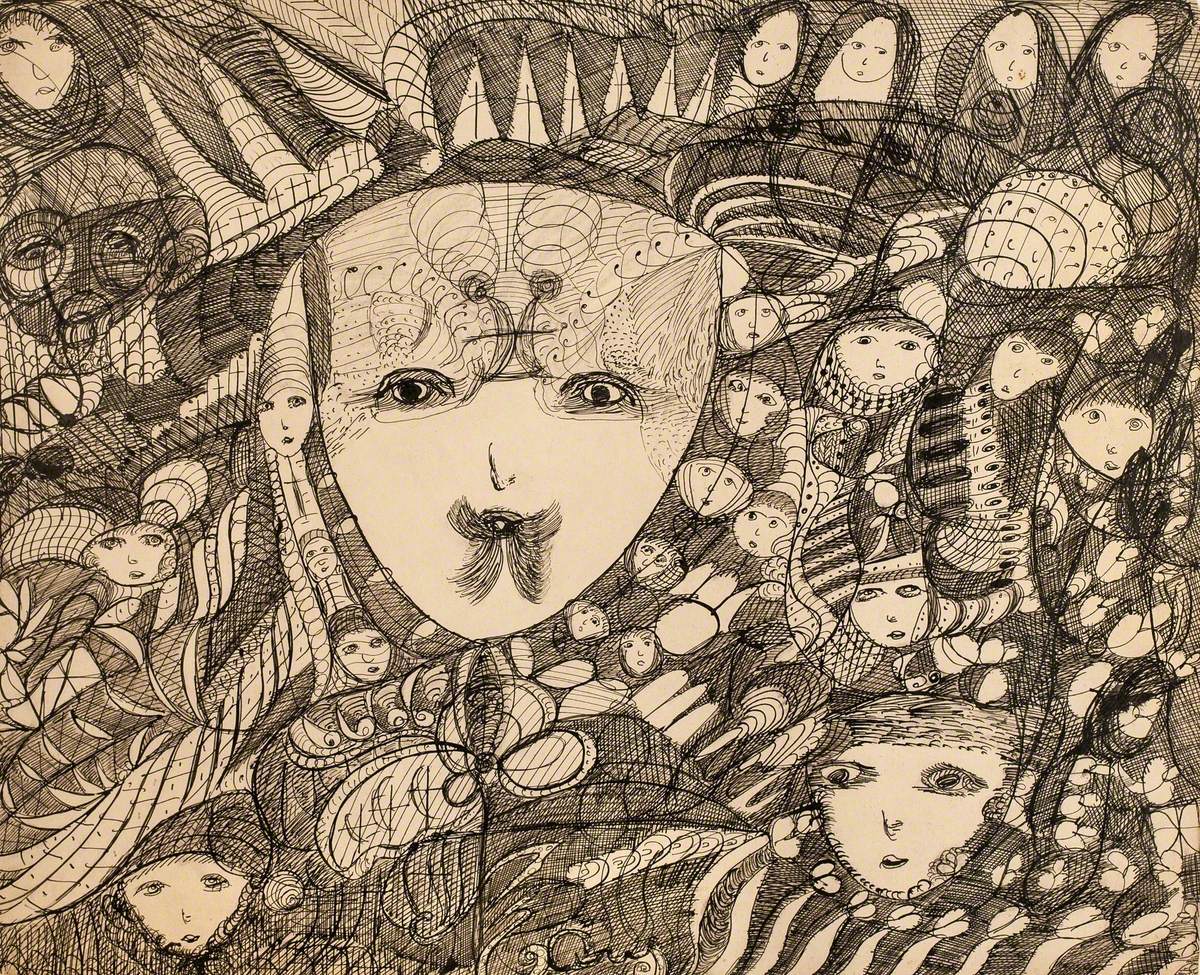
Cross-posted from babbo.dev/articles/ai-risk. To experience the piece in its intended form, please visit there.A Kishōtenketsu on AI Risk Faces*, Madge Gill, 1920–1960. Newham Archives and Local Studies Library I. The Will of Angels"Once upon a time a great Cabbalist lived in Prague, called the Rabbi Löw. He made a human figure of clay, and left a small aperture in the lesser brain in which he laid a parchment with the unutterable name of God written on it. The clod immediately arose and was a man; he performed all the duties of a servant for his creator, he fetched water, and hewed wood. All through the Jews' quarter he was known as the Golem of the great Rabbi Löw."— Berthold Auerbach, Spinoza (1837)[1][2]A common topic of interest in 18th-century French salons was the theodicy:[3] given an omnipotent, omnibenevolent God, why is there evil in the world?[4] This excited a range of answers. There was the Panglossian theodicy, the pollyannaish view that, "all is for the best [in] [...] the best of all possible worlds".[5] Others subscribed to the Irenaean theodicy that evil is necessary for full human development.[6]A particularly prominent theory though was one originally argued by Saint Augustine of Hippo. Pulling from the Neoplatonists, Augustine first contended that evil is not a thing in itself, but rather a privation of the good.[7] Then, in exercising free will, a great gift in itself, humans can move themselves away from the good.However, there seems to be a slight hole in this notion. While the theodicy is adequate for explaining human-derived evil, it does not resolve the 'problem of evil' in regard to natural sources; if evil extends from human freedom, where do we place natural disasters, diseases, or independent animal suffering?[8]To patch this issue, an addendum can be made to the theodicy in what is commonly referred to as the 'two falls theodicy'. In standard Catholic metaphysics, angels are aeviternal beings which apprehend 'intuitively' and whose wil