Guest post: How US renewable-energy growth persists despite federal policy uncertainty
Why this matters: environmental and climate reporting with long-term consequences.
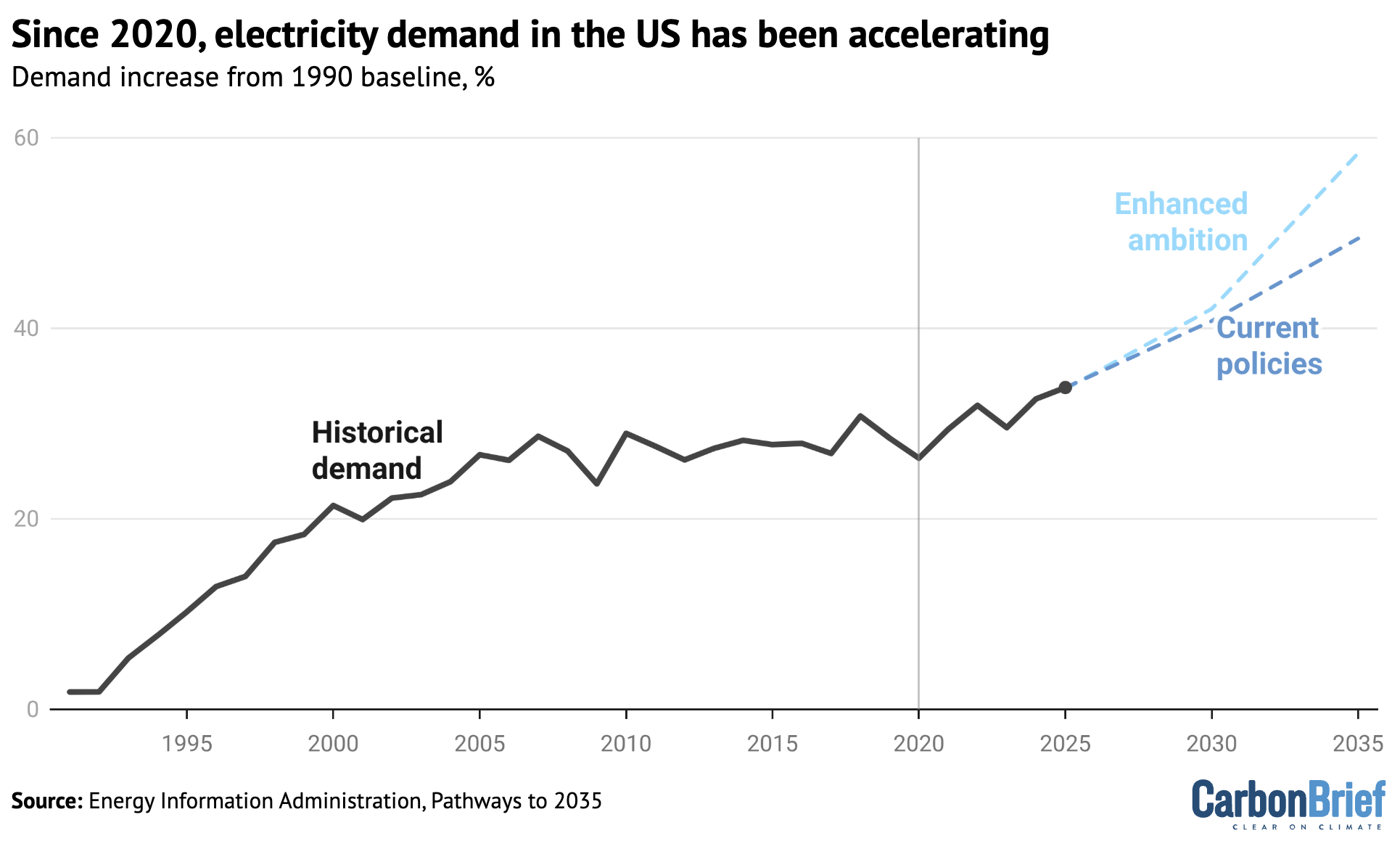
Despite recent shifts in federal energy policies, our analysis shows that the US transition to renewable energy is continuing. The current administration has enacted a range of changes to prioritise fossil-fuel energy and environmental deregulation in the US, while withdrawing support for renewables. Yet solar, wind and battery storage accounted for over 90% of new energy capacity in 2025. This is thanks to the falling cost of renewable energy technologies, investments spurred by the Inflation Reduction Act and Bipartisan Infrastructure Law and local and state policies, according to our research at the Center for Global Sustainability, University of Maryland. Our analysis examines recent trends in the US energy landscape, focusing on rising electricity demand, new electricity capacity additions and generation, as well as fossil-fuel production and state-level case studies. Rising electricity demand in the US A key shift in the calculus is the fact that US electricity demand is now projected to increase rapidly, after a period of relative stagnation. Between 2005 and 2020, electricity demand was relatively flat, after surging in the 1990s due to growth in the economy and population, as well as rising electrification. However, as the chart below shows, demand has grown by 7% since 2020 – and this is set to accelerate. Change in electricity demand relative to a 1990 baseline, %. Black line: Historical data. Red and blue lines: Projections under “current policies” and “enhanced climate action”, respectively. Source: Historical data from the Energy Information Administration. Projections from Pathways to 2035. Rising transport electrification, along with new demand from data centres, buildings and industry are expected to drive additional electricity growth in the near term. Our recent report finds that US electricity demand could increase by 24-34% in the next decade, relative to 2021 levels, as shown in the figure below. It shows that electricity demand would be higher