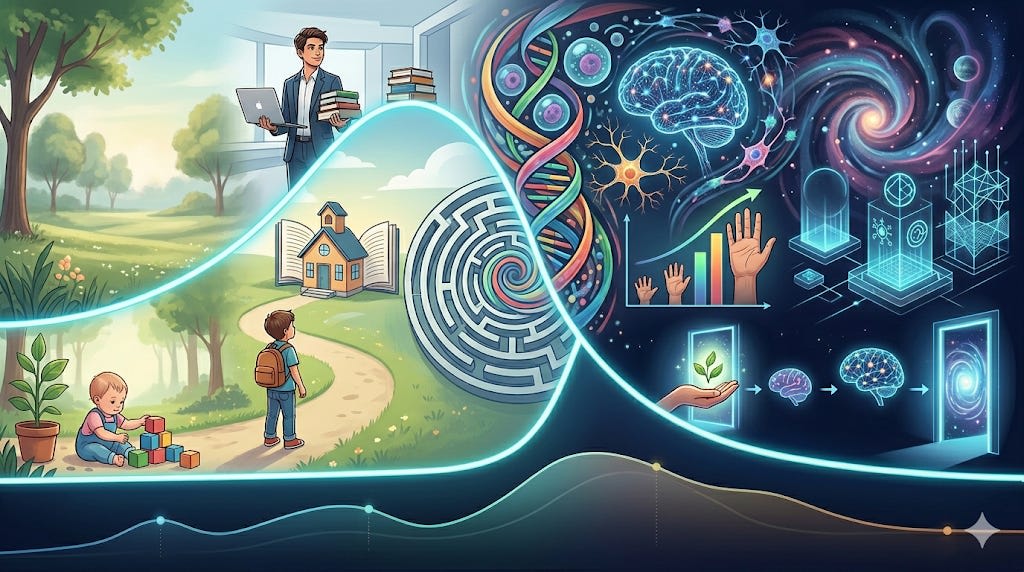
Leading and Trailing Edge of Development
The abbreviated thesis of developmental psychology is that, as we mature, we pass through various developmental stages. These might be moral, meaning-making, or ontological stages, but we typically think of them as distinct phases: a person exists at one stage and then enters another, never to return.This isn’t quite right, though. Development is more often uneven. A person might be in, say, Kegan’s Stage 4 in their professional life, but struggle with Stage 2 concerns in their romantic life, or vice-versa. Base developmental theories don’t adequately explain why this is, but I have a theory!First, let’s consider how people move through stages. It typically happens in what feel like quantized jumps. It might not happen in a single moment, but over a period of days, weeks, or months, it’ll become clear that a person has transitioned from one stage to the next. From the inside, transitioning to a new stage often feels like waking up from a dream or looking up to see there’s a wider world out there.But the transition to the new stage is at first unstable. For example, when an adolescent transitions from Kegan Stage 2 to 3, they don’t immediately drop all their Stage 2 behaviors. They might keep playing with favorite childhood toys or continue to struggle with being part of a team because they remain too focused on short-term goals. It often takes several years to fully leave Stage 2 behaviors behind, and Stage 2 behavior can come back in times of stress or grief.Something similar happens if/when adults make the transition from Stage 3 to 4 and from 4 to 5. In the 3 to 4 transition, one common pattern is for a person to transition to Stage 4 in their professional life, but remain in Stage 3 in their personal life. This is often the case for busy professionals, like doctors and lawyers who are brilliant at work but have messy personal lives. The opposite is also common, especially among women, where a person becomes an adept socialite in their personal life, but struggle