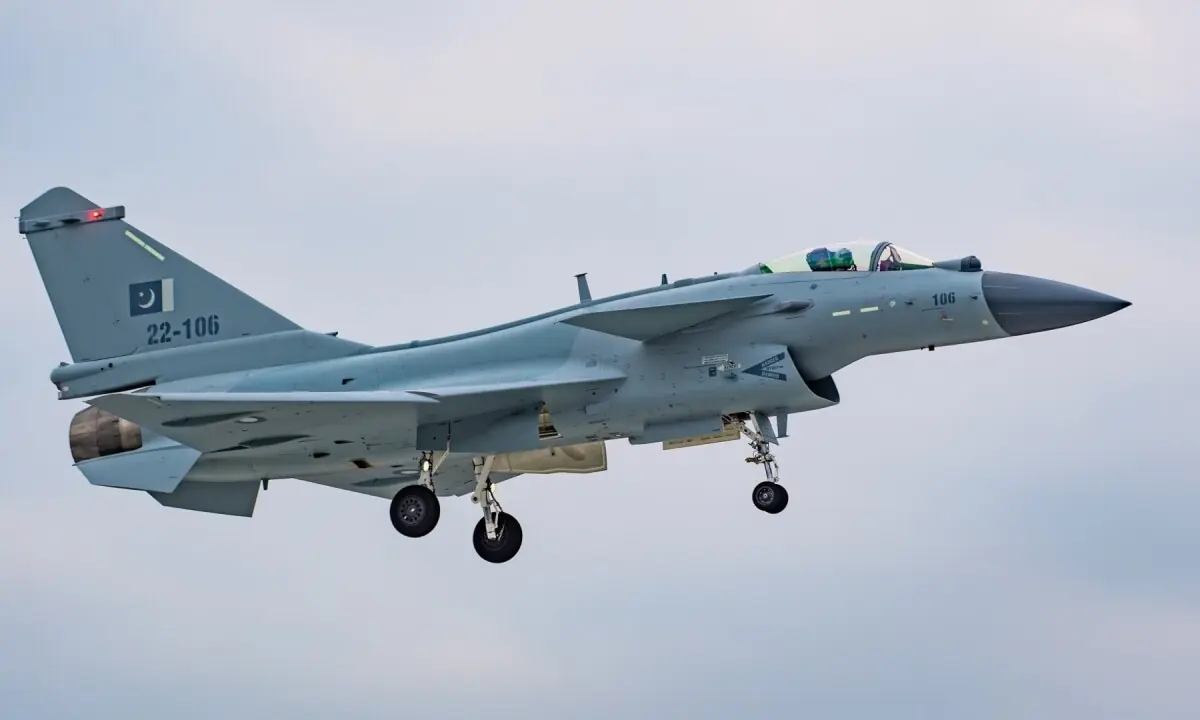
A look at the new capabilities Pakistan employed against India during Marka-i-Haq
Why this matters: local context for readers following news across Pakistan and the region.
A year ago, Pakistan and India fought a short but intense war — the worst military confrontation between the two nuclear-armed neighbours in decades. During the period of Marka-i-Haq (the battle for truth), Indian fighter jets were shot down, and Pakistan launched Operation Bunyanum Marsoos — a barrage of attacks against Indian military targets — in retaliation for missile strikes by New Delhi. The conflict ended with a US-brokered ceasefire. During the four-day war, Pakistan showcased a wide variety of weaponry and military technology, ranging from advanced missiles to network-linked warfare systems. Let’s take a look at some of them here. ‘Seeing without seeing’ — network-centric warfare One of the deadliest tools in Pakistan’s arsenal was unleashed in the early hours of May 7: the use of network-centric warfare. This doctrine involves sharing real-time data and information across multiple domains, such as between fighter jets, airborne early warning aircraft and ground-based command centres, to gain an advantage through the use of information sharing and battlefield awareness. This was achieved by integrating both Chinese and Western hardware into a single, coherent structure, with indigenously developed software. Intelligence and information were shared among ground assets, fighter jets and support aircraft in real time to detect incoming Indian jets on the first night of the conflict and establish a kill chain. It also allowed for “beyond visual range” combat — targeting aircraft over a hundred kilometres away and shooting down at least six Indian fighter jets, including French-made Dassault Rafales. Brigadier (retd) Masood Ahmed told Dawn that the use of real-time data sharing enabled Pakistan Air Force pilots to “see” Indian aircraft from beyond visual range, and they “laid an ambush” for incoming Indian Air Force jets. The future of warfare in the present — drones Unmanned Aerial Systems (UAS) can carry out a wide array of tasks — ranging from surveillance t