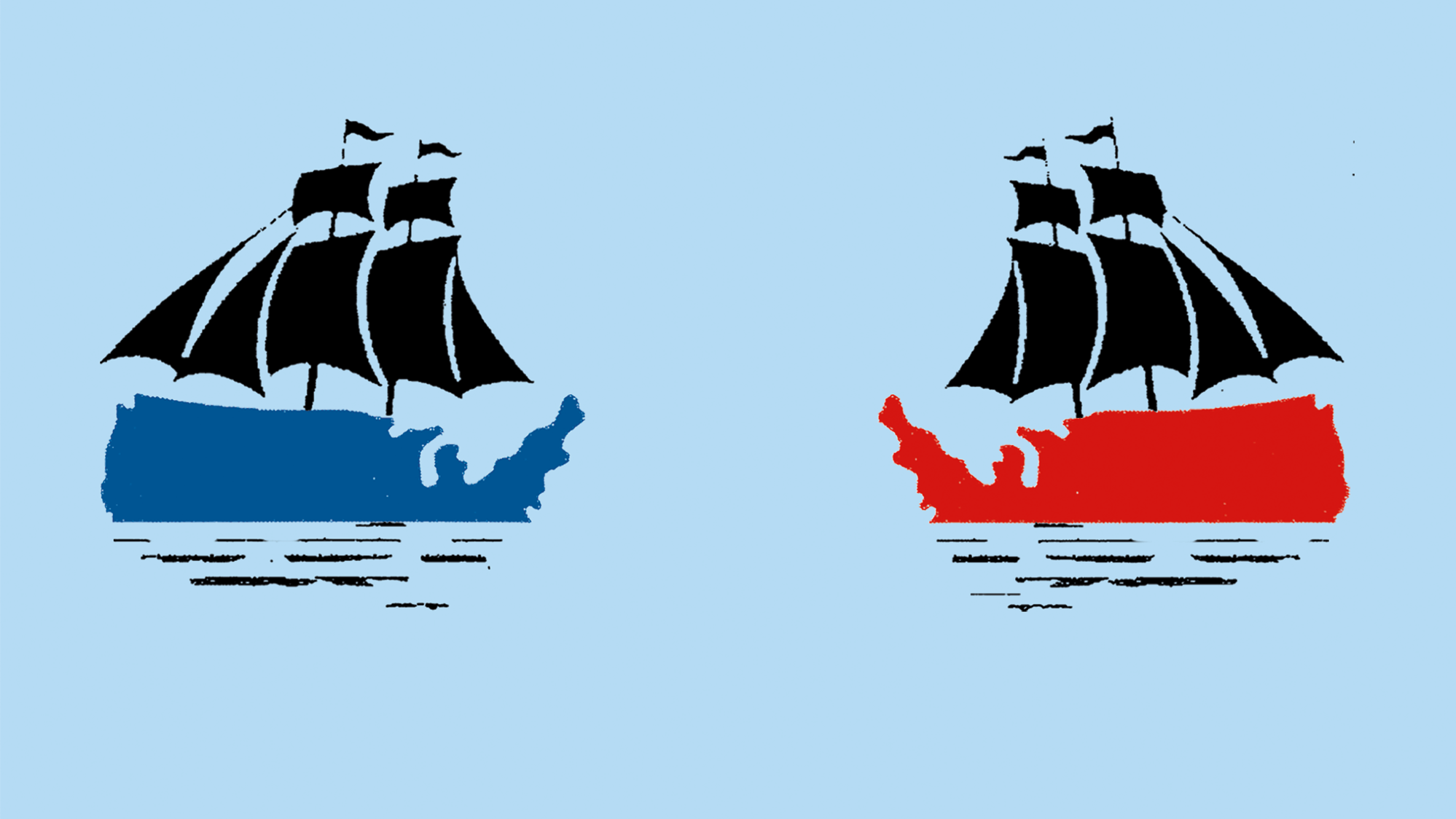
The Slave Ship and the Mayflower
Are Americans one people, or many? Our national motto, “e pluribus unum,” seems to offer the definitive answer to the question: We are many, but one. Even on the verge of the Civil War, Abraham Lincoln insisted in his first inaugural address that Americans were united by “the mystic chords of memory” stretching back to Revolutionary battlefields and Patriot graves. In the aftermath of the war, as millions of Irish, English, and German immigrants swarmed to our shores, Frederick Douglass began delivering a talk titled “Composite Nation,” which celebrated both the pluribus and the unum. “Gathered here from all quarters of the globe,” Americans are bound to one another “by a common aspiration for national liberty as against caste, divine-right government and privileged classes,” he declared—with premature optimism, to say the least.Others regard the unum as a pious myth. In Who Are We? (2004), the political scientist Samuel Huntington mocked the beloved shibboleth of “a nation of immigrants” as “a misleading falsehood”; America was in fact an “Anglo-Protestant” nation at risk of disintegration due to the pressures of multiculturalism. In a similar vein, Vice President Vance has claimed that Americans who can trace their ancestry to those who fought in the Civil War are more American than those who can’t.The historian David Hackett Fischer articulated a more intriguing, and certainly less divisive, view in Albion’s Seed: Four British Folkways in America (1989). He endorsed a modern spin on what he called the “germ theory” of American history—first advanced, Fischer wrote, by 19th-century historians who described the “Teutonic germs” of liberty migrating from Germany to England to the New World. In Fischer’s version, early immigrants from four different regions of Great Britain established cultures in different regions of the American colonies. Though fewer than a fifth of Americans had British ancestry at the time of Fischer’s writing, “in a cultural sense,” he provocat