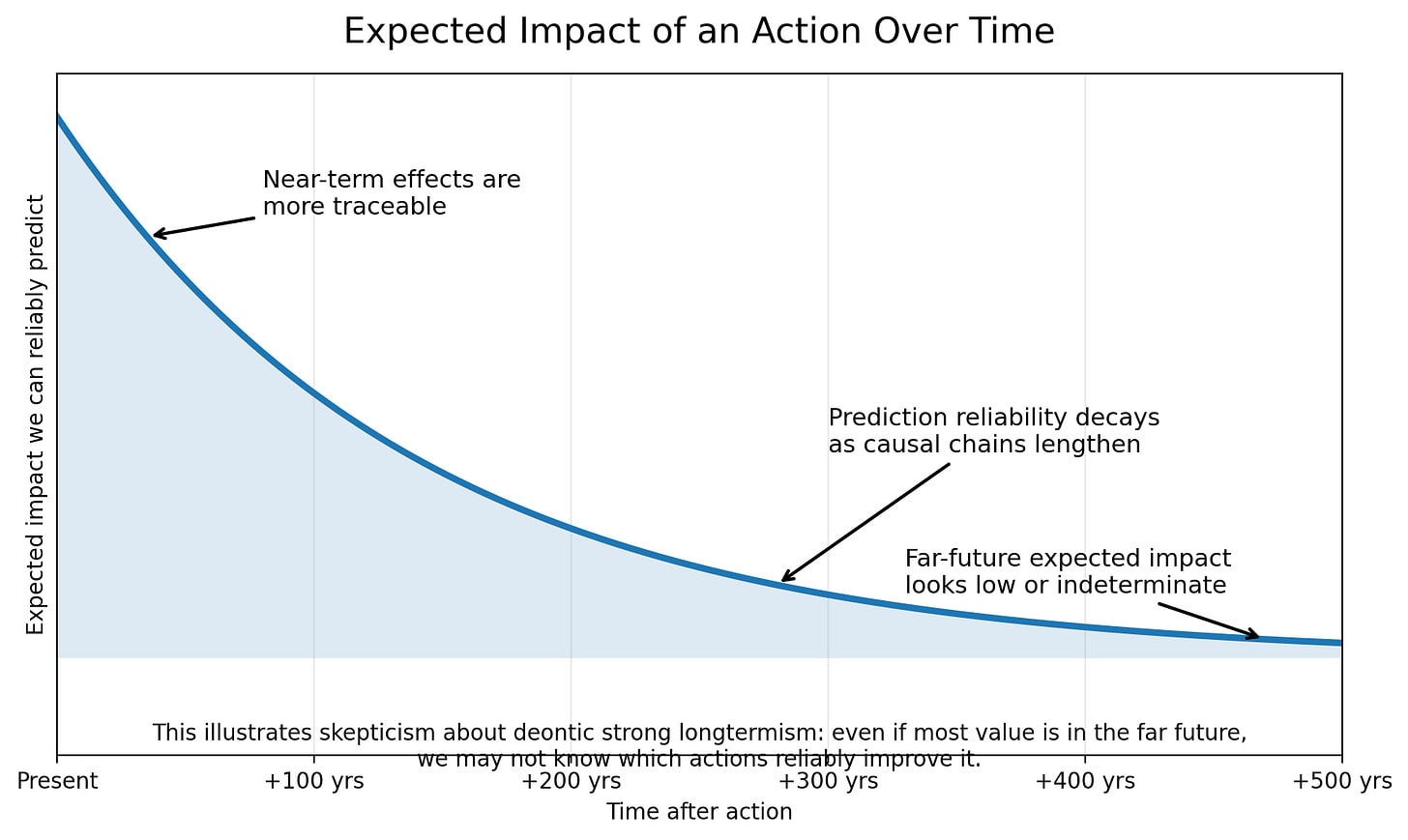
Strong Longtermism Is Simply Correct
Crosspost. 1 Strong Longtermism explained Strong Longtermism is the idea that the most important features of our actions concern how they affect the long-run future. The case for it is very simple. The future could contain ridiculously large numbers of people—10^58 by some estimates, far more by others. While humanity might die off soon, we might survive for billions of years. What we do today has some chance of affecting things over cosmic timescales—vaster than empires and more slow.Thus, nearly all the expected impact of our actions is on future people. For every present person our actions affect, there are many times more future people they affect. Insofar as future people matter, and make up nearly 100% of those affected by our actions, then most of what matters in what we do is how our actions affect the far future.It’s very intuitive that future people matter morally. To give the canonical example, imagine that you put down a shard of glass that a child would step on. Does it matter if the child is alive currently or won’t be born for a hundred years? Certainly it wouldn’t make a huge difference.Likewise, if pressing a button would make future people’s lives 10% less good, even if it would hugely benefit present people, we shouldn’t press it. The takeaway from this: individual future people matter significantly. Because future people are so much more numerous than present people, they matter more in the aggregate, just as the total population of Asia matters more than the population of a random small town.A rough analogy to make the case for strong Longtermism clear: imagine that we discovered that there were giant civilizations that lived in caves. In fact, while exact numbers were hard to predict, in expectation 99.999999999999999999999999999999% of total people lived in caves. Suppose additionally that our actions affected the cave people in huge numbers. Policies routinely affected trillions of expected cave people for every non-cave person they affected.