Gears for political races
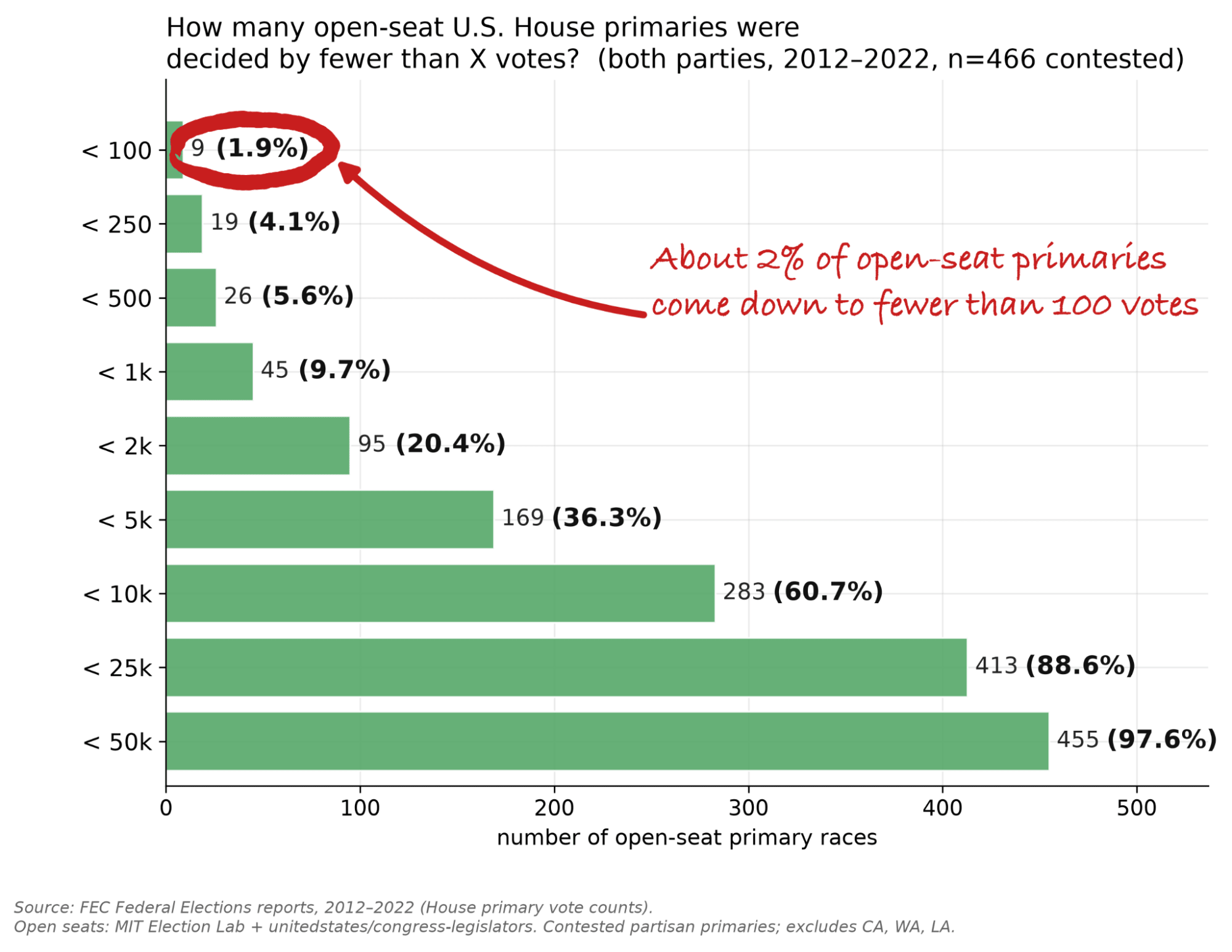
In the past few years, many people around me have tried to convince me that US electoral politics is important. But like many other people in the community, I’ve been suspicious of many of the high-level arguments that I’ve heard. It felt like people were pulling numbers out of poorly-documented models I didn’t have time to examine and citing studies I didn’t have time to read. But I lacked a gears-level model of why and how individual efforts could impact electoral outcomes, and I felt intimidated by all the statistics and skeptical of trusting people adjacent to politics.In the past year, as I’ve done more research and (more recently) volunteered on the ground to help Alex Bores’s campaign in NY-12[1] (the guy who passed the RAISE Act and is now being targeted by the giant A16Z, Greg Brockman, Joe Lonsdale Super PAC), I’ve developed a gears-level understanding of how electoral politics in the US works.I now believe that working on US electoral politics is one of the highest impact areas from the general AIS perspective. I feel like I was a fool. In this post, I’ll share some of the gears I’ve learned that inform this belief, with a focus on those that would’ve been most informative to my past self.~2% of open-seat primaries come down to 100 votes or lessI’ve often heard that “every vote counts” and “this race is close” and I’ve shrugged it off and assumed there was no way I could actually make the difference in practice. I now think this was clearly wrong. For example, ~2% of open-seat primaries come down to 100 votes or less!And that’s not even accounting for which races seem close or not. There’s not much to be done for races with an obvious frontrunner, but when the polls are neck-and-neck, the odds of a race coming down to just a handful of votes are even higher.[2](CA, WA, and LA are excluded because of nonstandard rules: CA/WA use a top-two primary, and LA uses an all-party November ballot with a runoff if no one exceeds 50%, none of which produce a separate